

Latest Juniper JN0-105 Practice Test Questions, Junos, Associate (JNCIA-Junos) Exam Dumps
Jul-2026 Pass Juniper JN0-105 Exam in First Attempt Easily
NEW QUESTION # 61
Which two statements are correct about Junos traceoptions? (Choose two.)
- A. Traceoptions are enabled by default.
- B. Traceoptions cannot be enabled in a production environment.
- C. Traceoptions are enabled through configuration.
- D. Traceoption output, by default, is stored in /var/iog/<fiie-name>.
Answer: C,D
NEW QUESTION # 62
Which two statements are true about the PFE? (Choose two.)
- A. The PFE implements various services such as policing, stateless firewall filtering, and class of service.
- B. The PFE uses Layer 2 and Layer 3 forwarding tables to forward traffic toward its destination.
- C. The PFE handles all processes that control the chassis components.
- D. The PFE is responsible for performing protocol updates and system management.
Answer: A,B
Explanation:
The Packet Forwarding Engine (PFE) in Juniper Networks devices is the heart of the data plane, handling the actual forwarding of packets based on pre-computed forwarding tables. It provides several critical services to manage and control traffic flow, including policing (to enforce bandwidth limits for certain traffic types), stateless firewall filtering (to permit or deny traffic based on predefined criteria), and Class of Service (CoS) (to prioritize traffic to ensure quality of service for critical applications). The PFE utilizes both Layer 2 (MAC addresses) and Layer 3 (IP addresses) forwarding tables to make intelligent forwarding decisions, ensuring that packets are efficiently routed toward their final destination.
NEW QUESTION # 63
You are configuring a firewall filter on a Juniper device.
In this scenario, what are two valid terminating actions? (Choose two.)
- A. 2discarD
- B. 4accept
- C. 3next term
- D. 1 count
Answer: A,B
Explanation:
In Juniper firewall filter configurations, "discard" and "accept" are two valid terminating actions for a term within a filter. The "discard" action drops the packet, preventing it from reaching its intended destination, while the "accept" action allows the packet to pass through the filter, proceeding to its next hop or destination.
"Count" is a non-terminating action that increments a counter every time a packet matches the term but does not inherently determine the packet's fate. "Next term" directs the evaluation to proceed to the next term in the filter for further processing, also a non-terminating action.
NEW QUESTION # 64
Click the Exhibit button.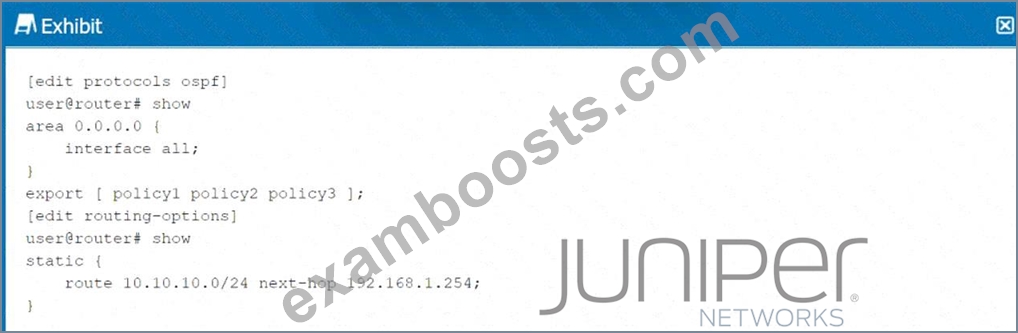
Referring to the exhibit, OSPF has three export policies that match different static route prefixes. The
10.10.10.0/24 static route does not match any terms in the policyl routing policy.
What happens next in this scenario?
- A. Thestaticrouteisevaluated by the poiicy3 routing policy.
- B. Thestaticrouteisrejected by the default routing policy.
- C. Thestaticrouteisevaluated by the poiicy2 routing policy.
- D. Thestaticrouteisrejected by the policyl routing policy.
Answer: C
Explanation:
In Junos, when multiple policies are applied to a routing protocol for route export, the routes are evaluated in the order in which the policies are listed. In the exhibit, the OSPF configuration has three export policies listed: policy1, policy2, and policy3. The static route 10.10.10.0/24 does not match any terms in policy1; therefore, it is not rejected by policy1 but is instead passed on to the next policy in the sequence, which is policy2.
If the static route matches a term in policy2 that permits the route, it will be exported into OSPF. If it does not match in policy2, it will then be evaluated by policy3. If there is no match in policy3 as well, and assuming there are no more policies listed, the route would then be subject to the default routing policy behavior, which typically rejects the route unless an explicit accept statement is present in the policies.
NEW QUESTION # 65
Exhibit
term limit-icmp { from {
source-address {
172.25.11.0/24;
}
protocol icmp;
}
then {
count count-icmp; discard;
}
}
Referring to the exhibit, which two actions will occur when a packet matches the firewall filter? (Choose two.)
- A. An ICMP destination unreachable message will be returned.
- B. The packet will be discarded.
- C. A counter will be incremented.
- D. The packet will be forwarded.
Answer: B
Explanation:
Referring to the firewall filter configuration in the exhibit, when a packet matches the specified term limit-icmp, two actions are defined in thethenstatement:count count-icmpanddiscard. Thecount count-icmp action means that each time a packet matches this term, a counter namedcount-icmpwill be incremented, providing a tally of how many packets have matched the term. Thediscardaction means that the packet will be dropped and not forwarded through the device. This effectively prevents the packet from reaching its intended destination. There is no action specified that would cause an ICMP destination unreachable message to be returned, nor is there any action that would allow the packet to be forwarded.
NEW QUESTION # 66
Which prompt indicates that you are using configuration mode?
- A. %
- B. >
- C. #
- D. $
Answer: C
Explanation:
In Junos OS, the # prompt indicates that you are in configuration mode. This mode is used for making changes to the configuration of the device.
Reference: Juniper Networks CLI Modes
"The # prompt indicates that you are in configuration mode."
NEW QUESTION # 67
Exhibit.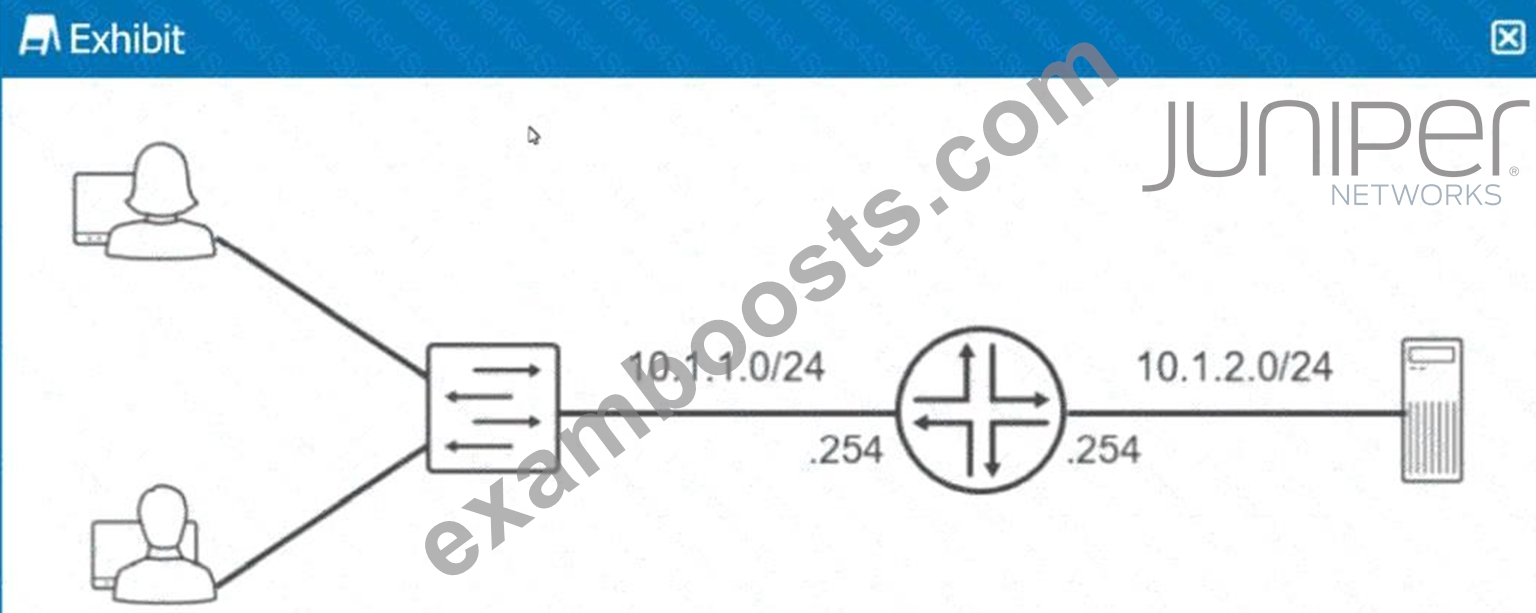
Referring to the exhibit, which routing configuration is required for these two users to access the remote server?
- A. Trunk ports must be enabled on the switch.
- B. A routing protocol must be enabled on the router.
- C. Users must connect directly to the router.
- D. Users and the server require a default gateway.
Answer: D
Explanation:
For the users in the 10.1.1.0/24 subnet and the server in the 10.1.2.0/24 subnet to communicate with each other, they need to route packets through the router that connects these two subnets. Each user and the server need to have their default gateway set to the IP address of the router interface on their respective subnet (.
254). This ensures that packets destined for other subnets are sent to the router, which then routes them to the correct destination subnet.
References:
Juniper official documentation: Configuring Basic Routing.
General networking principles.
NEW QUESTION # 68
By default, how does the PFE manage unicast traffic destined for an existing forwarding table entry?
- A. It sends the traffic through one port toward its destination.
- B. It sends the traffic through the f xpl interface to the RE.
- C. It sends all traffic to the control plane for further processing.
- D. It sends the traffic through multiple ports toward its destination.
Answer: A
Explanation:
In a Juniper Networks device, the Packet Forwarding Engine (PFE) processes unicast traffic by forwarding it according to the existing entries in the forwarding table. When the PFE encounters unicast traffic destined for an address that has a corresponding entry in the forwarding table, it directs the traffic through a specific outgoing interface or port toward its destination. This process is based on the most efficient path determined by the routing protocols in use, ensuring that the packet reaches its intended destination through a singular path, unless specific configurations such as load balancing are in place.
NEW QUESTION # 69
Which two statements about firewall filters are correct? (Choose two.)
- A. Firewall filters can match Layer 4 parameters.
- B. Firewall filters are stateless.
- C. Firewall filters can match Layer 7 parameters.
- D. Firewall filters are stateful.
Answer: A,B
Explanation:
Firewall filters in Junos OS are stateless, meaning they process each packet individually without regard to the state of a connection or sequence of packets. These filters can match various packet attributes, including those at Layer 4, such as TCP and UDP port numbers. This allows for granular control over traffic based on the type of service or application. Unlike stateless filters, stateful firewalls keep track of the state of active connections and make decisions based on the context of the traffic flow, which is not a capability of Junos firewall filters.
Additionally, Junosfirewall filters primarily operate up to Layer 4 and do not natively inspect Layer 7 parameters, which involve application-level data.
NEW QUESTION # 70
Exhibit
policy-options { policy-statement Load-Balance-Policy { term Load-Balance { then { load-balance per-flow; accept;
}
}
}
}
routing-options {
router-id 192.168.100.11; autonomous-system 65201; forwarding-table {
export Load-Balance-Policy;
Referring to the exhibit, which two statements are correct? (Choose two.)
- A. The policy enables flow-based load balancing.
- B. The policy enables per-packet load balancing.
- C. The policy must be applied under the protocols hierarchy.
- D. The policy enables equal cost load balancing in the forwarding table.
Answer: A,D
Explanation:
The load-balance per-flow statement in the Junos OS policy-options configuration enables flow-based load balancing in the forwarding table. This means that the traffic is distributed across multiple paths based on flows, where a flow is typically identified by attributes such as source and destination IP addresses, and possibly layer 4 information like TCP/UDP ports. This allows for more granular and efficient utilization of available paths, avoiding overloading a single path. The policy does not enable per-packet load balancing, which would send individual packets of the same flow over different paths, potentially causing out-of-order delivery issues. The policy's placement in the forwarding-table export suggests it's intended to influence forwarding behavior, not just routing protocol decisions, and does not necessarily have to be applied under the protocols hierarchy.
NEW QUESTION # 71
Which command modifier would you use to see all possible completions for a specific command?
- A. detail
- B. extensive
- C. |
- D. ?
Answer: D
Explanation:
In Junos OS, the ? command modifier is used to display all possible completions for a specific command. This helps users understand the available options and syntax for a command they are trying to use.
Reference:
"Use the ? command modifier to display all possible completions for a specific command."
NEW QUESTION # 72
Which two components are included in a transport header? (Choose two.)
- A. destination port number
- B. source MAC address
- C. destination MAC address
- D. source port number
Answer: A,D
Explanation:
The transport layer in the OSI model is responsible for end-to-end communication and error recovery. In a transport header, such as TCP or UDP, the key components include the source port number and the destination port number. These port numbers are used to identify sending and receiving applications. The source port number indicates the port of the sending application, and the destination port number refers to the port of the receiving application. MAC addresses, on the other hand, are part of the data link layer (Layer 2) and would be included in an Ethernet header, not a transport header.
NEW QUESTION # 73
Click the Exhibit button.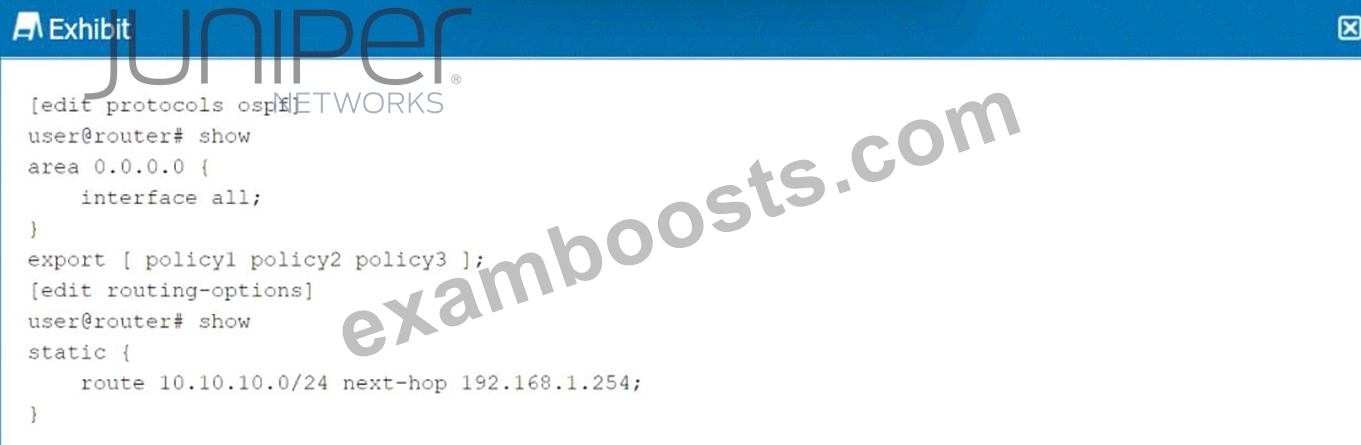
Referring to the exhibit, OSPF has three export policies that match different static route prefixes. The
10.10.10.0/24 static route does not match any terms in the policyl routing policy.
What happens next in this scenario?
- A. Thestaticrouteisevaluated by the poiicy3 routing policy.
- B. Thestaticrouteisrejected by the default routing policy.
- C. Thestaticrouteisevaluated by the poiicy2 routing policy.
- D. Thestaticrouteisrejected by the policyl routing policy.
Answer: C
Explanation:
In Junos, when multiple policies are applied to a routing protocol for route export, the routes are evaluated in the order in which the policies are listed. In the exhibit, the OSPF configuration has three export policies listed: policy1, policy2, and policy3. The static route 10.10.10.0/24 does not match any terms in policy1; therefore, it is not rejected by policy1 but is instead passed on to the next policy in the sequence, which is policy2.
If the static route matches a term in policy2 that permits the route, it will be exported into OSPF. If it does not match in policy2, it will then be evaluated by policy3. If there is no match in policy3 as well, and assuming there are no more policies listed, the route would then be subject to the default routing policy behavior, which typically rejects the route unless an explicit accept statement is present in the policies.
NEW QUESTION # 74
You are asked to configure your device running Junos OS to automatically archive your configuration upon commit In this scenario, which two methods are supported by the Junos OS? (Choose two)
- A. SCP
- B. RCP
- C. HTTP
- D. FTP
Answer: A,B
Explanation:
Junos OS supports multiple methods for automatically archiving configurations upon commit. Two of the supported methods are SCP (Secure Copy Protocol) and RCP (Remote Copy Protocol). These methods can be configured to save the configuration files to a remote server automatically whenever a commit is made.
Reference: Juniper Networks Documentation on Configuration Archival
"You can configure Junos OS to automatically archive the configuration using protocols such as SCP and RCP upon commit."
NEW QUESTION # 75
Which Junos feature limits the amount of exception traffic that is sent from the PFE to the RE?
- A. CoS markings
- B. routing policy
- C. scheduler
- D. policer
Answer: D
Explanation:
In Junos OS, a policer is a feature used to limit the rate of traffic flow in the network, including exception traffic sent from the Packet Forwarding Engine (PFE) to the Routing Engine (RE). Exception traffic consists of packets that cannot be processed by the PFE alone and requireintervention by the RE, such as control packets or packets destined for the device itself. A policer can be configured to enforce bandwidth limits and drop or mark packets that exceed specified rate limits, thus protecting the RE from being overwhelmed by excessive exception traffic.
NEW QUESTION # 76
What are two methods for navigating to configuration mode from an operational mode prompt? (Choose two.)
- A. Use the quit command.
- B. Use the edit command.
- C. Use the exit command.
- D. Use the configure command.
Answer: B,D
Explanation:
In Junos OS, to navigate from operational mode to configuration mode, you can use either theeditorconfigure command. Both commands move the CLI from operational mode, where you can view the state of the device, to configuration mode, where you can make changes to the device's configuration.
NEW QUESTION # 77
You are logged in to a Junos OS device with SSH and issued the show protocols | compare command in the configuration, but no output is shown.
Which statement is correct in this scenario?
- A. You must commit the configuration before any output will be shown.
- B. Someone accidentally deleted the active configuration.
- C. The command only works for interface configuration differences.
- D. There are no changes to the candidate configuration.
Answer: D
Explanation:
The show | compare command in Junos OS is used to display the differences between the candidate configuration and the active configuration. If no output is shown when you issue this command, it means that there are no changes between the candidate configuration and the active configuration. This indicates that the candidate configuration is identical to the active configuration, and thus no differences are displayed.
Reference:
"The show | compare command displays the differences between the candidate configuration and the active configuration. If there are no changes, no output is displayed."
NEW QUESTION # 78
You have configured some interfaces on a Junos device; however, you have not yet committed the configuration.
What happens if you issue the rollback 0 command in this scenario?
- A. The interface changes you made are discarded.
- B. The messages.log file is deleted.
- C. The Junos device is rebooted.
- D. The factory default configuration is loaded.
Answer: A
Explanation:
Issuing the rollback 0 command in Junos OS will discard any uncommitted changes and revert to the last committed configuration. This command effectively cancels any configuration changes that have been made but not yet committed, ensuring that the device returns to its previous stable state.
References:
* "rollback 0 ...................................(rolls back the changes just made )" from Useful Juniper Commands.
txt.
* Juniper official documentation: Rolling Back a Configuration.
NEW QUESTION # 79
Click the Exhibit button.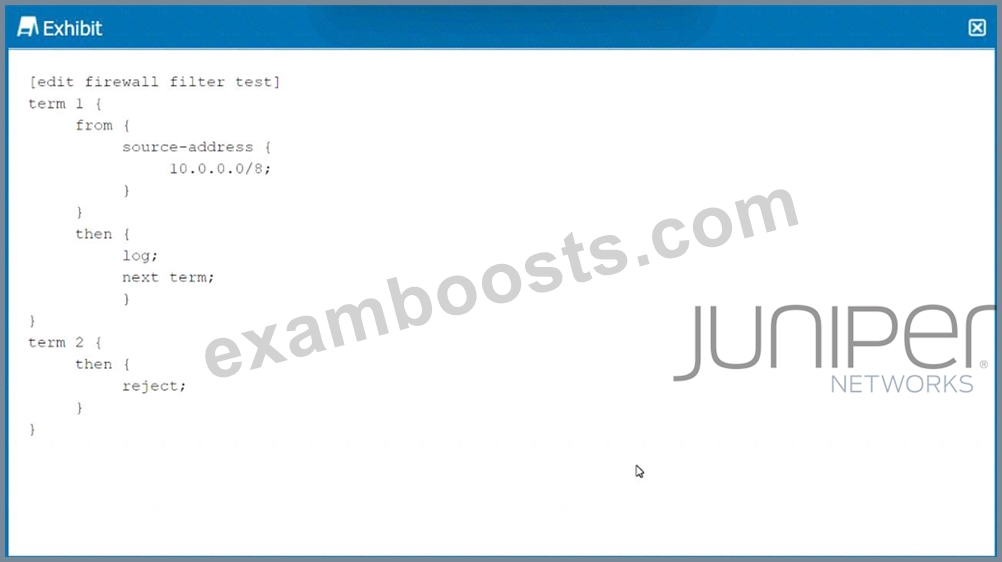
How is traffic, sourced from 10.0.0.0/8, treated by the firewall filter shown in the exhibit?
- A. logged and rejected
- B. logged and accepted
- C. logged and discarded
- D. logged with no further action
Answer: B
Explanation:
The firewall filter configuration in the exhibit specifies a filter with two terms. Term 1 matches traffic from the source address 10.0.0.0/8 and has two actions: 'log' and 'next term'. The 'log' action will record the match to a log file, and 'next term' indicates that the firewall should evaluate the next term after logging. There is no explicit action such as 'accept' or 'reject' in term 1, so by default, the traffic will be accepted unless subsequently rejected by another term.
Term 2 has the action 'reject', which discards packets that reach this term. Since there is no 'from' condition in term 2, it acts as a default rule for all traffic not matched by term 1.
Because the traffic sourced from 10.0.0.0/8 matches term 1 and there is no reject action in that term, it will be logged and then accepted by the firewall filter. There is no subsequent term that rejects this specific traffic, so the action from term 2 does not apply to it.
NEW QUESTION # 80
Which three benefits occur when operating an interior gateway protocol (IGP) in an autonomous system (AS)? (Choose three.)
- A. IGPs automatically distribute static routing information.
- B. IGPs learn prefixes in the global Internet's routing table.
- C. IGPs react very fast to network change.
- D. IGPs determine the optimal paths for data transmission.
- E. IGPs learn everything about the subnets and best paths within your network.
Answer: C,D,E
Explanation:
Operating an Interior Gateway Protocol (IGP) within an Autonomous System (AS) provides several benefits, including determining the optimal paths for data transmission (B), reacting quickly to network changes (D), and learning all about the subnets and best paths within the network (E). IGPs are designed to manage routing within a single AS efficiently, adapting to changes and ensuring data is routed through the best available paths.
NEW QUESTION # 81
Your router has a route to the 10.1.1.0/24 network with a next hop of r jet.
In this scenario, which action will your router perform when traffic destined to the 10.1.1.0/24 network is received?
- A. The traffic will be discarded and an ICMP unreachable message will be sent to the source of the traffic.
- B. The traffic will be discarded and an ICMP unreachable message will be sent to the destination of the traffic.
- C. The traffic will be redirected using a default route.
- D. The traffic will be silently discarded.
Answer: D
Explanation:
In a scenario where a router has a route to a specific network (in this case, 10.1.1.0/24) with a next hop that is unreachable or incorrectly specified (e.g., "r jet" seems to be a typo or an undefined entity), the router will typically discard the traffic destined for that network. This action is taken because the router cannot determine a valid path to forward the traffic. Unlike some scenarios where the router might generate an ICMP (Internet Control Message Protocol) unreachable message, in many configurations, especially in production networks, the traffic might be silently discarded without providing feedback to the sender, as generating ICMP messages for all undeliverable packets could lead to additional network congestion and potential security concerns.
NEW QUESTION # 82
Which two statements are correct about a Routing Engine? (Choose two.)
- A. It processes management traffic.
- B. It processes CoS marked traffic.
- C. It forwards transit traffic.
- D. It maintains routing tables.
Answer: A,D
Explanation:
The Routing Engine (RE) in Juniper Networks devices plays a pivotal role in the control plane, handling tasks that are critical for the operation and management of the network. One of its key functions is processing management traffic, which includes user commands, system configuration, and monitoring operations. The RE also maintains routing tables, which are essential for network routing decisions. These tables contain network topology information and routing paths, which the RE uses to update the Packet Forwarding Engine (PFE) so that it can forward packets appropriately. The RE does not forward transit traffic or process Class of Service (CoS) marked traffic, as these tasks are handled by the PFE.
NEW QUESTION # 83
Which type of device uses the destination IP address to forward packets?
- A. Layer 3 router
- B. Layer 2 switch
- C. repeater
- D. hub
Answer: A
Explanation:
A Layer 3 router forwards packets based on the destination IP address. It operates at the network layer of the OSI model and uses routing tables to determine the best path for packet delivery. Unlike Layer 2 switches, which forward packets based on MAC addresses, routers handle logical addressing, making them crucial for inter-network communication.
NEW QUESTION # 84
Click the Exhibit button.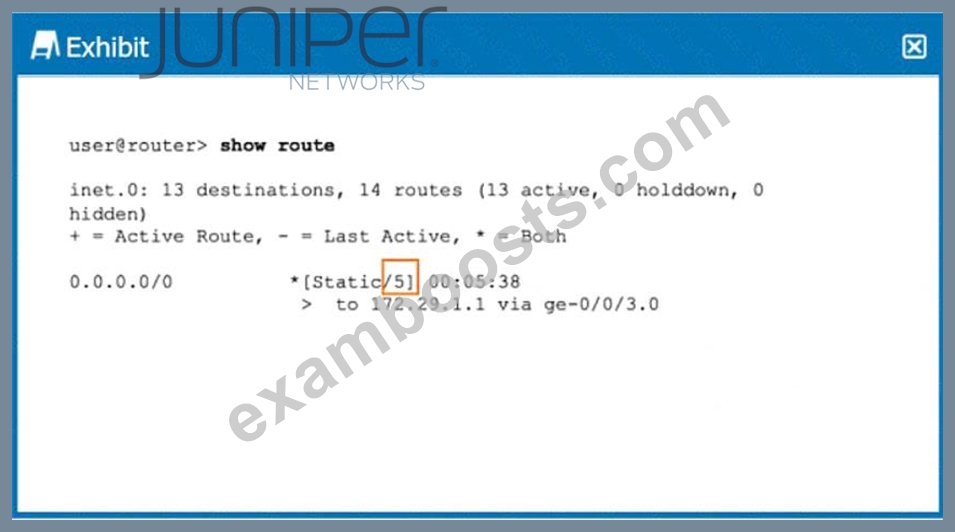
Referring the exhibit, what does the highlighted number indicate?
- A. cost is 5
- B. metric is 5
- C. route preference is 5
- D. hop count is 5
Answer: C
Explanation:
In the exhibit shown, the highlighted number next to the route type (Static) within the square brackets indicates the route preference, also known as the administrative distance. In Junos, the route preference is a value that determines the priority of the route source. Lower numbers indicate a higher priority when the routing table is being calculated. The route preference is used to select the best route when multiple paths to the same destination exist from different routing sources. The number 5 is unusually low for a static route by default, suggesting it has been manually configured to override other route types.
NEW QUESTION # 85
Which two statements describe the result when you enter? at the command-line prompt? (Choose two.)
- A. It displays summary information about the commands and options.
- B. It lists tips for the help menu.
- C. It lists the available commands and options.
- D. It displays help about a text string contained in a statement.
Answer: A,C
Explanation:
When you enter ? at the command-line prompt in Junos OS, the system provides assistance in two significant ways. Firstly, it lists the available commands and options that can be used at the current point in the command hierarchy, aiding users in understanding what commands they can execute next. Secondly, it displays summary information about those commands and options, providing brief descriptions or additional context that can help users understand the function of each command or option. This feature is particularly useful for learning the command structure or for quick reference when specific command syntax is forgotten.
NEW QUESTION # 86
......
Juniper JN0-105 Exam Syllabus Topics:
| Topic | Details |
|---|---|
| Topic 1 |
|
| Topic 2 |
|
| Topic 3 |
|
Free JN0-105 Exam Files Downloaded Instantly 100% Dumps & Practice Exam: https://www.examboosts.com/Juniper/JN0-105-practice-exam-dumps.html
Updated Verified JN0-105 dumps Q&As - 100% Pass Guaranteed: https://drive.google.com/open?id=1tiDVnKhz71qWgkhNkbmjgVT8UP2MRvEo