

Ultimate Guide to Prepare PCEP-30-02 Certification Exam for Python Institute PCEP in 2026
Use Real PCEP-30-02 Dumps - Python Institute Correct Answers updated on 2026
Python Institute PCEP-30-02 Exam Syllabus Topics:
| Topic | Details |
|---|---|
| Topic 1 |
|
| Topic 2 |
|
| Topic 3 |
|
NEW QUESTION # 11
Arrange the code boxes in the correct positions in order to obtain a loop which executes its body with the level variable going through values 5, 1, and 1 (in the same order).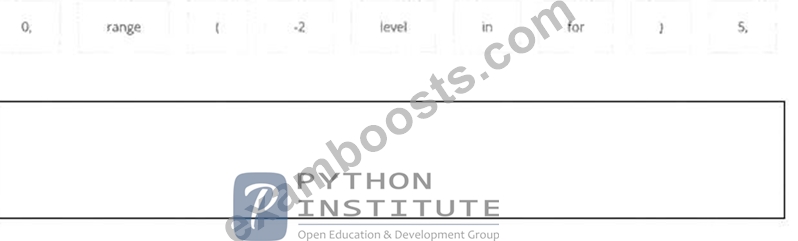
Answer:
Explanation: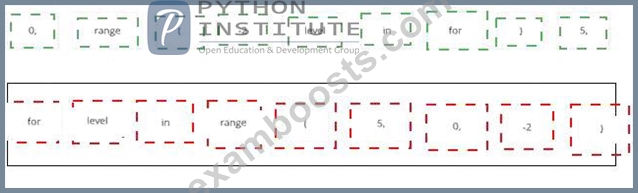

NEW QUESTION # 12
Arrange the binary numeric operators in the order which reflects their priorities, where the top-most position has the highest priority and the bottom-most position has the lowest priority.
Answer:
Explanation:
Explanation: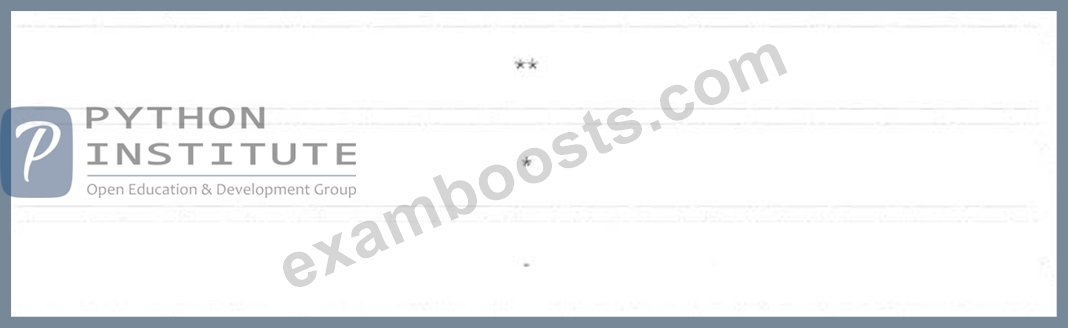
The correct order of the binary numeric operators in Python according to their priorities is:
* Exponentiation (**)
* Multiplication (*) and Division (/, //, %)
* Addition (+) and Subtraction (-)
This order follows the standard mathematical convention of operator precedence, which can be remembered by the acronym PEMDAS (Parentheses, Exponents, Multiplication/Division, Addition/Subtraction).
Operators with higher precedence are evaluated before those with lower precedence, but operators with the same precedence are evaluated from left to right. Parentheses can be used to change the order of evaluation by grouping expressions.
For example, in the expression 2 + 3 * 4 ** 2, the exponentiation operator (**) has the highest priority, so it is evaluated first, resulting in 2 + 3 * 16. Then, the multiplication operator (*) has the next highest priority, so it is evaluated next, resulting in 2 + 48. Finally, the addition operator (+) has the lowest priority, so it is evaluated last, resulting in 50.
You can find more information about the operator precedence in Python in the following references:
* 6. Expressions - Python 3.11.5 documentation
* Precedence and Associativity of Operators in Python - Programiz
* Python Operator Priority or Precedence Examples Tutorial
NEW QUESTION # 13
Python Is an example of which programming language category?
- A. compiled
- B. machine
- C. assembly
- D. interpreted
Answer: D
Explanation:
Explanation
Python is an interpreted programming language, which means that the source code is translated into executable code by an interpreter at runtime, rather than by a compiler beforehand. Interpreted languages are more flexible and portable than compiled languages, but they are also slower and less efficient. Assembly and machine languages are low-level languages that are directly executed by the hardware, while compiled languages are high-level languages that are translated into machine code by a compiler before execution.
NEW QUESTION # 14
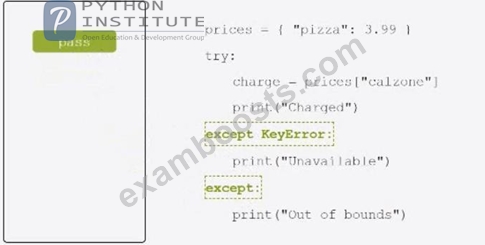
Drag and drop the code boxes in order to build a program which prints Unavailable to the screen.
(Note: one code box will not be used.)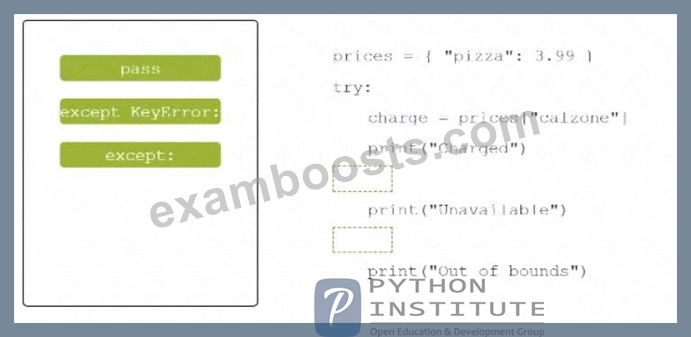
Answer:
Explanation: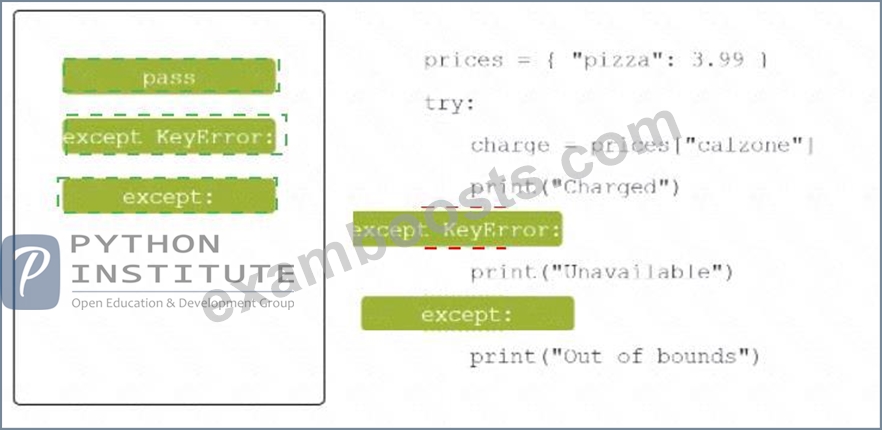
NEW QUESTION # 15
What is the expected result of running the following code?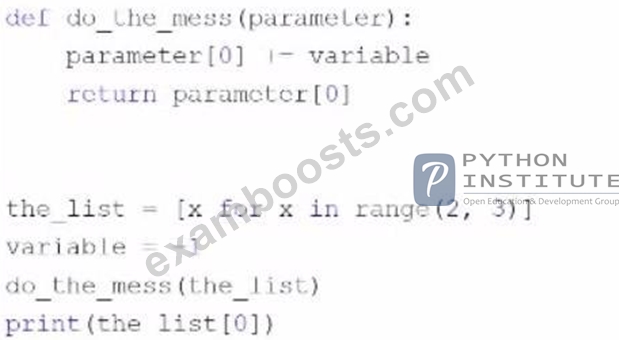
- A. The code prints 2
- B. The code raises an unhandled exception.
- C. The code prints 1 .
- D. The code prints 0
Answer: B
Explanation:
Explanation
The code snippet that you have sent is trying to use the index method to find the position of a value in a list.
The code is as follows:
the_list = [1, 2, 3, 4, 5] print(the_list.index(6))
The code starts with creating a list called "the_list" that contains the numbers 1, 2, 3, 4, and 5. Then, it tries to print the result of calling the index method on the list with the argument 6. The index method is used to return the first occurrence of a value in a list. For example, the_list.index(1) returns 0, because 1 is the first value in the list.
However, the code has a problem. The problem is that the value 6 is not present in the list, so the index method cannot find it. This will cause a ValueError exception, which is an error that occurs when a function or operation receives an argument that has the right type but an inappropriate value. The code does not handle the exception, and therefore it will terminate with an error message.
The expected result of the code is an unhandled exception, because the code tries to find a value that does not exist in the list. Therefore, the correct answer is C. The code raises an unhandled exception.
NEW QUESTION # 16
What is true about tuples? (Select two answers.)
- A. An empty tuple is written as { } .
- B. Tuples are immutable, which means that their contents cannot be changed during their lifetime.
- C. The len { } function cannot be applied to tuples.
- D. Tuples can be indexed and sliced like lists.
Answer: B,D
Explanation:
Tuples are one of the built-in data types in Python that are used to store collections of data. Tuples have some characteristics that distinguish them from other data types, such as lists, sets, and dictionaries. Some of these characteristics are:
* Tuples are immutable, which means that their contents cannot be changed during their lifetime. Once a tuple is created, it cannot be modified, added, or removed. This makes tuples more stable and reliable than mutable data types. However, this also means that tuples are less flexible and dynamic than mutable data types. For example, if you want to change an element in a tuple, you have to create a new tuple with the modified element and assign it to the same variable12
* Tuples are ordered, which means that the items in a tuple have a defined order and can be accessed by using their index. The index of a tuple starts from 0 for the first item and goes up to the length of the tuple minus one for the last item. The index can also be negative, in which case it counts from the end of the tuple. For example, if you have a tuple t = ("a", "b", "c"), then t[0] returns "a", and t
[-1] returns "c"12
* Tuples can be indexed and sliced like lists, which means that you can get a single item or a sublist of a tuple by using square brackets and specifying the start and end index. For example, if you have a tuple t
= ("a", "b", "c", "d", "e"), then t[2] returns "c", and t[1:4] returns ("b", "c", "d"). Slicing does not raise any exception, even if the start or end index is out of range. It will just return an empty tuple or the closest possible sublist12
* Tuples can contain any data type, such as strings, numbers, booleans, lists, sets, dictionaries, or even other tuples. Tuples can also have duplicate values, which means that the same item can appear more than once in a tuple. For example, you can have a tuple t = (1, 2, 3, 1, 2), which contains two 1s and two
2s12
* Tuples are written with round brackets, which means that you have to enclose the items in a tuple with parentheses. For example, you can create a tuple t = ("a", "b", "c") by using round brackets. However, you can also create a tuple without using round brackets, by just separating the items with commas. For example, you can create the same tuple t = "a", "b", "c" by using commas. This is called tuple packing, and it allows you to assign multiple values to a single variable12
* The len() function can be applied to tuples, which means that you can get the number of items in a tuple by using the len() function. For example, if you have a tuple t = ("a", "b", "c"), then len(t) returns 312
* An empty tuple is written as (), which means that you have to use an empty pair of parentheses to create a tuple with no items. For example, you can create an empty tuple t = () by using empty parentheses.
However, if you want to create a tuple with only one item, you have to add a comma after the item, otherwise Python will not recognize it as a tuple. For example, you can create a tuple with one item t = ("a",) by using a comma12 Therefore, the correct answers are A. Tuples are immutable, which means that their contents cannot be changed during their lifetime. and D. Tuples can be indexed and sliced like lists.
Reference: Python Tuples - W3SchoolsTuples in Python - GeeksforGeeks
NEW QUESTION # 17
What is the expected result of the following code?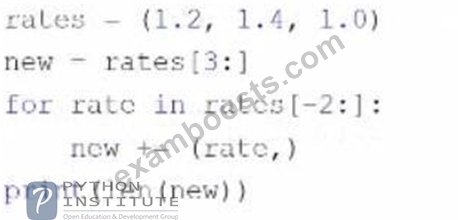
- A. The code will cause an unhandled
- B. 0
- C. 1
- D. 2
Answer: A
Explanation:
Explanation
The code snippet that you have sent is trying to use a list comprehension to create a new list from an existing list. The code is as follows:
my_list = [1, 2, 3, 4, 5] new_list = [x for x in my_list if x > 5]
The code starts with creating a list called "my_list" that contains the numbers 1, 2, 3, 4, and 5. Then, it tries to create a new list called "new_list" by using a list comprehension. A list comprehension is a concise way of creating a new list from an existing list by applying some expression or condition to each element. The syntax of a list comprehension is:
new_list = [expression for element in old_list if condition]
The expression is the value that will be added to the new list, which can be the same as the element or a modified version of it. The element is the variable that takes each value from the old list. The condition is an optional filter that determines which elements will be included in the new list. For example, the following list comprehension creates a new list that contains the squares of the even numbers from the old list:
old_list = [1, 2, 3, 4, 5, 6] new_list = [x ** 2 for x in old_list if x % 2 == 0] new_list = [4, 16, 36]The code that you have sent is trying to create a new list that contains the elements from the old list that are greater than 5. However, there is a problem with this code. The problem is that none of the elements in the old list are greater than 5, so the condition is always false. This means that the new list will be empty, and the expression will never be evaluated. However, the expression is not valid, because it uses the variable x without defining it. This will cause a NameError exception, which is an error that occurs when a variable name is not found in the current scope. The code does not handle the exception, and therefore it will terminate with an error message.
The expected result of the code is an unhandled exception, because the code tries to use an undefined variable in an expression that is never executed. Therefore, the correct answer is D. The code will cause an unhandled exception.
NEW QUESTION # 18
What is the expected output of the following code?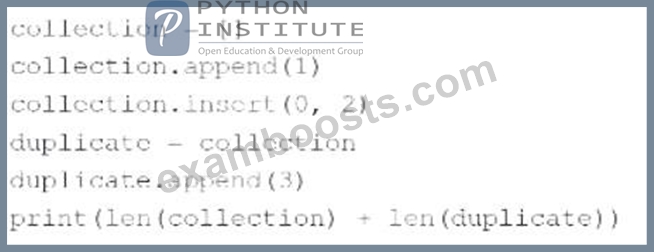
- A. 0
- B. 1
- C. The code raises an exception and outputs nothing.
- D. 2
Answer: C
Explanation:
The code snippet that you have sent is trying to print the combined length of two lists, "collection" and
"duplicate". The code is as follows:
collection = [] collection.append(1) collection.insert(0, 2) duplicate = collection duplicate.append(3) print(len (collection) + len(duplicate)) The code starts with creating an empty list called "collection" and appending the number 1 to it. The list now contains [1]. Then, the code inserts the number 2 at the beginning of the list. The list now contains [2, 1].
Then, the code creates a new list called "duplicate" and assigns it the value of "collection". However, this does not create a copy of the list, but rather a reference to the same list object. Therefore, any changes made to
"duplicate" will also affect "collection", and vice versa. Then, the code appends the number 3 to "duplicate".
The list now contains [2, 1, 3], and so does "collection". Finally, the code tries to print the sum of the lengths of "collection" and "duplicate". However, this causes an exception, because the len function expects a single argument, not two. The code does not handle the exception, and therefore outputs nothing.
The expected output of the code is nothing, because the code raises an exception and terminates. Therefore, the correct answer is D. The code raises an exception and outputs nothing.
Reference: [Python Institute - Entry-Level Python Programmer Certification]
NEW QUESTION # 19
What is true about tuples? (Select two answers.)
- A. An empty tuple is written as { } .
- B. Tuples are immutable, which means that their contents cannot be changed during their lifetime.
- C. The len { } function cannot be applied to tuples.
- D. Tuples can be indexed and sliced like lists.
Answer: B,D
Explanation:
Explanation
Tuples are one of the built-in data types in Python that are used to store collections of data. Tuples have some characteristics that distinguish them from other data types, such as lists, sets, and dictionaries. Some of these characteristics are:
Tuples are immutable, which means that their contents cannot be changed during their lifetime. Once a tuple is created, it cannot be modified, added, or removed. This makes tuples more stable and reliable than mutable data types. However, this also means that tuples are less flexible and dynamic than mutable data types. For example, if you want to change an element in a tuple, you have to create a new tuple with the modified element and assign it to the same variable12 Tuples are ordered, which means that the items in a tuple have a defined order and can be accessed by using their index. The index of a tuple starts from 0 for the first item and goes up to the length of the tuple minus one for the last item. The index can also be negative, in which case it counts from the end of the tuple. For example, if you have a tuple t = ("a", "b", "c"), then t[0] returns "a", and t[-1] returns "c"12 Tuples can be indexed and sliced like lists, which means that you can get a single item or a sublist of a tuple by using square brackets and specifying the start and end index. For example, if you have a tuple t
= ("a", "b", "c", "d", "e"), then t[2] returns "c", and t[1:4] returns ("b", "c", "d"). Slicing does not raise any exception, even if the start or end index is out of range. It will just return an empty tuple or the closest possible sublist12 Tuples can contain any data type, such as strings, numbers, booleans, lists, sets, dictionaries, or even other tuples. Tuples can also have duplicate values, which means that the same item can appear more than once in a tuple. For example, you can have a tuple t = (1, 2, 3, 1, 2), which contains two 1s and two
2s12
Tuples are written with round brackets, which means that you have to enclose the items in a tuple with parentheses. For example, you can create a tuple t = ("a", "b", "c") by using round brackets. However, you can also create a tuple without using round brackets, by just separating the items with commas. For example, you can create the same tuple t = "a", "b", "c" by using commas. This is called tuple packing, and it allows you to assign multiple values to a single variable12 The len() function can be applied to tuples, which means that you can get the number of items in a tuple by using the len() function. For example, if you have a tuple t = ("a", "b", "c"), then len(t) returns 312 An empty tuple is written as (), which means that you have to use an empty pair of parentheses to create a tuple with no items. For example, you can create an empty tuple t = () by using empty parentheses.
However, if you want to create a tuple with only one item, you have to add a comma after the item, otherwise Python will not recognize it as a tuple. For example, you can create a tuple with one item t = ("a",) by using a comma12 Therefore, the correct answers are A.
Tuples are immutable, which means that their contents cannot be changed during their lifetime. and D. Tuples can be indexed and sliced like lists.
NEW QUESTION # 20
Drag and drop the literals to match their data type names.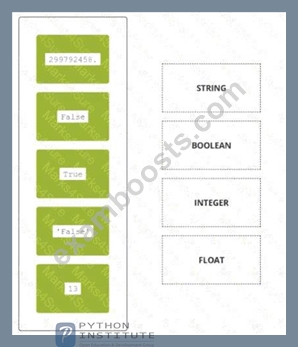
Answer:
Explanation: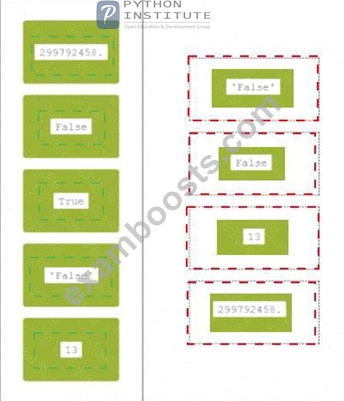
Explanation: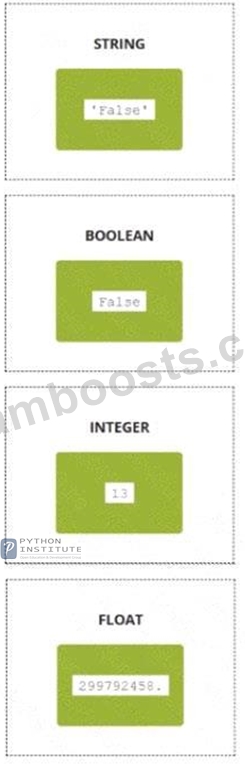
NEW QUESTION # 21
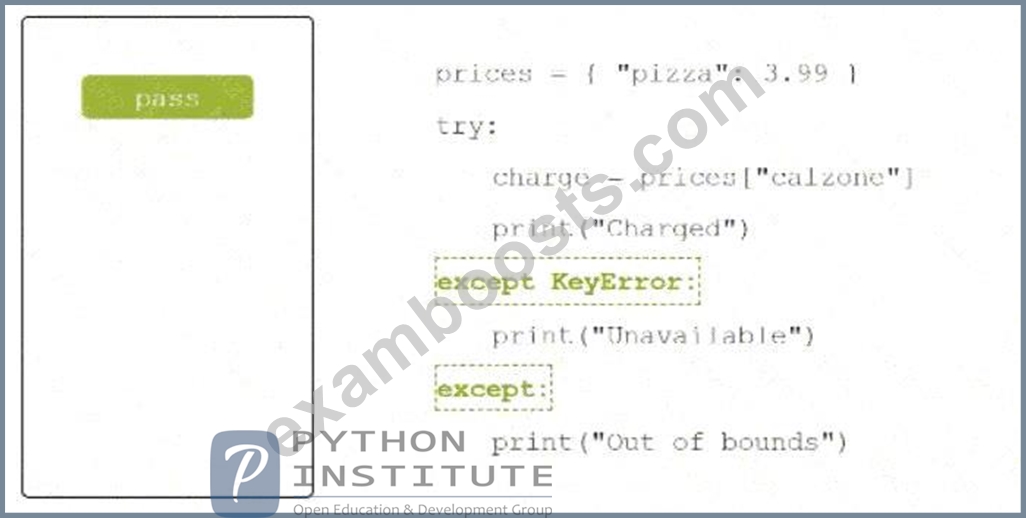
Drag and drop the code boxes in order to build a program which prints Unavailable to the screen.
(Note: one code box will not be used.)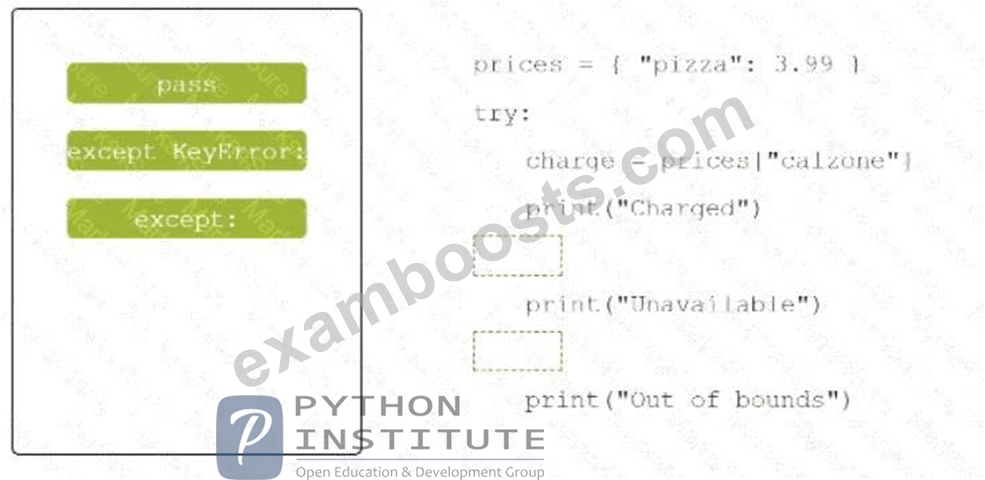
Answer:
Explanation: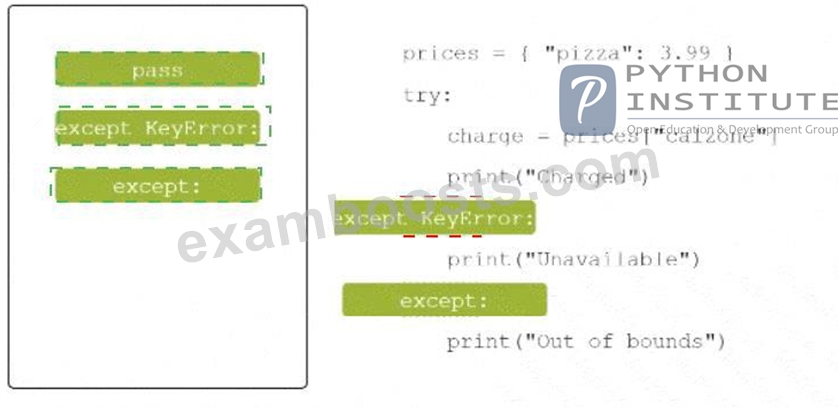
NEW QUESTION # 22
Arrange the code boxes in the correct positions in order to obtain a loop which executes its body with the level variable going through values 5, 1, and 1 (in the same order).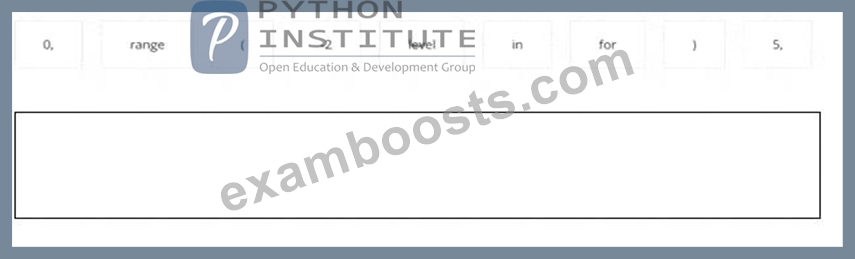
Answer:
Explanation: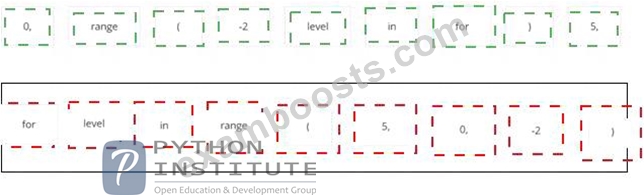

NEW QUESTION # 23
Which of the following are the names of Python passing argument styles?
(Select two answers.)
- A. indicatory
- B. positional
- C. keyword
- D. reference
Answer: B,C
Explanation:
Explanation
Keyword arguments are arguments that are specified by using the name of the parameter, followed by an equal sign and the value of the argument. For example, print (sep='-', end='!') is a function call with keyword arguments. Keyword arguments can be used to pass arguments in any order, and to provide default values for some arguments1.
Positional arguments are arguments that are passed in the same order as the parameters of the function definition. For example, print ('Hello', 'World') is a function call with positional arguments. Positional arguments must be passed before any keyword arguments, and they must match the number and type of the parameters of the function2.
References: 1: 5 Types of Arguments in Python Function Definitions | Built In 2: python - What's the pythonic way to pass arguments between functions ...
NEW QUESTION # 24
Insert the code boxes in the correct positions in order to build a line of code which asks the user for a float value and assigns it to the mass variable.
(Note: some code boxes will not be used.)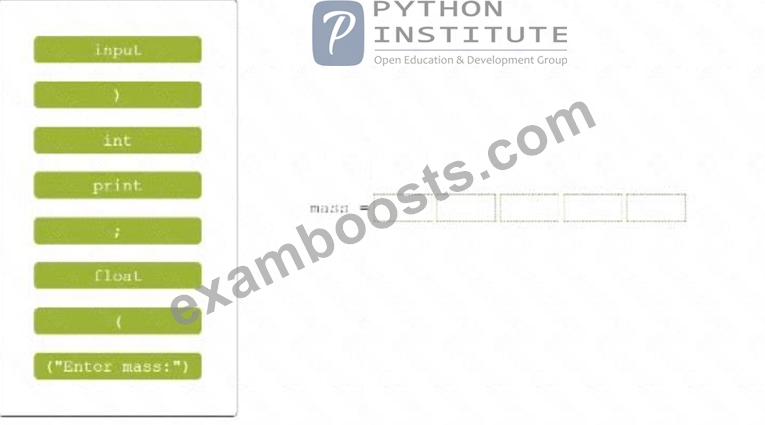
Answer:
Explanation: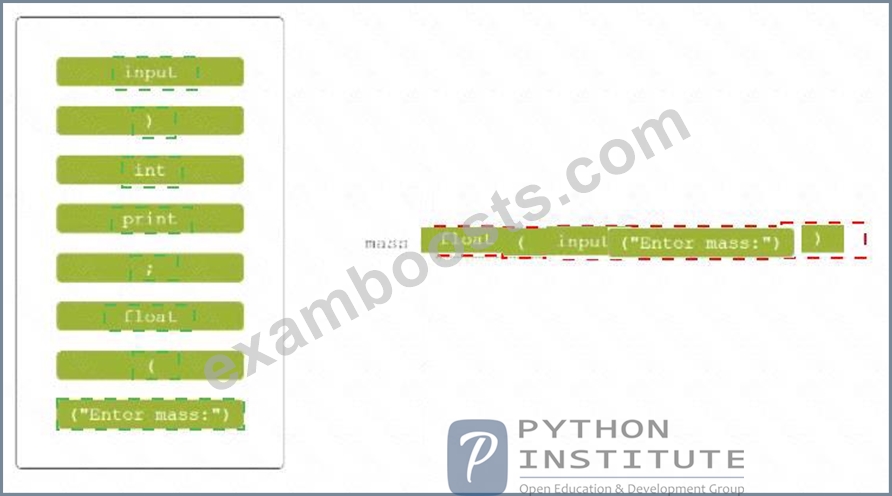
Explanation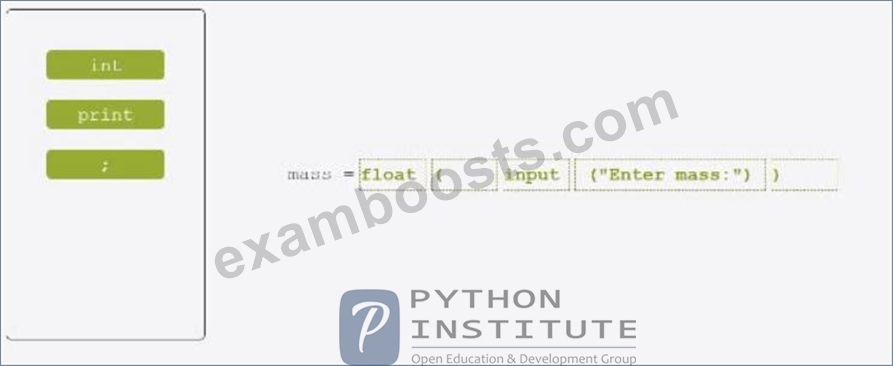
One possible way to insert the code boxes in the correct positions in order to build a line of code that asks the user for a float value and assigns it to the mass variable is:
mass = float(input("Enter the mass:
This line of code uses the input function to prompt the user for a string value, and then uses the float function to convert that string value into a floating-point number. The result is then assigned to the variable mass.
You can find more information about the input and float functions in Python in the following references:
[Python input() Function]
[Python float() Function]
NEW QUESTION # 25
Insert the code boxes in the correct positions in order to build a line of code which asks the user for an Integer value and assigns it to the counter variable.
(Note: some code boxes will not be used.)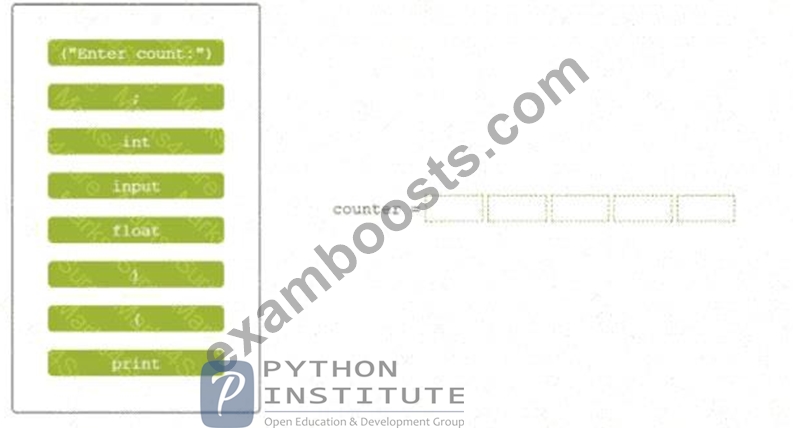
Answer:
Explanation: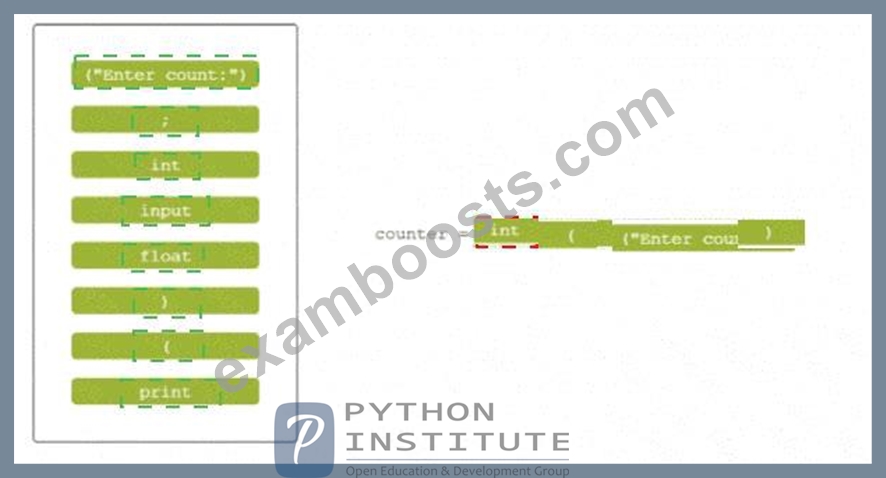

NEW QUESTION # 26
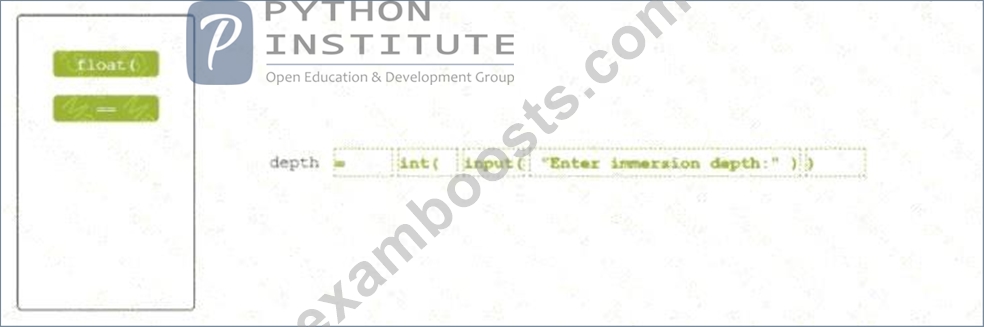
Insert the code boxes in the correct positions in order to build a line of code which asks the user for an Integer value and assigns it to the depth variable.
(Note: some code boxes will not be used.)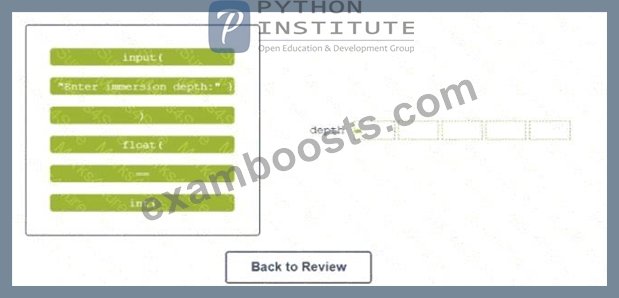
Answer:
Explanation: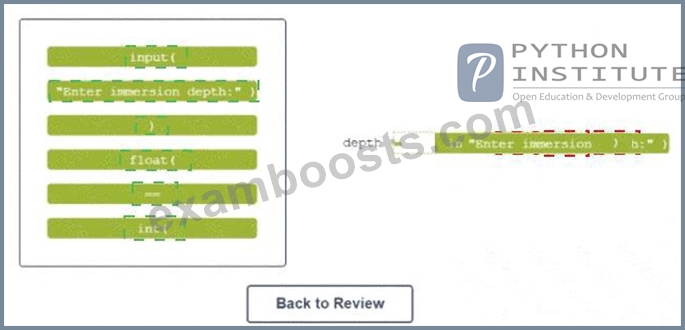
NEW QUESTION # 27
......
Python Institute PCEP -PCEP-30-02 Exam-Practice-Dumps: https://www.examboosts.com/Python-Institute/PCEP-30-02-practice-exam-dumps.html
PCEP-30-02 Premium Files Test pdf - Free Dumps Collection: https://drive.google.com/open?id=1sw66kyu186iBdVbrpdqcIhxsGa3KAZ9Q