

[Full-Version] 2025 New 200-101 Actual Exam Dumps, Facebook Practice Test
Study HIGH Quality 200-101 Free Study Guides and Exams Tutorials
NEW QUESTION # 33
Which statement describes an EIGRP feasible successor route?
- A. Abackup route, added to the topology table
- B. Abackup route, added to the routing table
- C. Aprimary route, added to the topology table
- D. Aprimary route, added to the routing table
Answer: A
NEW QUESTION # 34
What is the result of issuing the frame-relay map ip 192.168.1.2 202 broadcast command?
- A. defines the DLCI that is used for all packets that are sent to the 192.168.1.2 IP address
- B. defines the destination IP address that is used in all broadcast packets on DCLI 202
- C. defines the DLCI on which packets from the 192.168.1.2 IP address are received
- D. defines the source IP address that is used in all broadcast packets on DCLI 202
Answer: A
Explanation:
Frame-relay map ip 192.168.1.2 202 command statically defines a mapping between a network layer address and a DLCI. The broadcast option allows multicast and broadcast packets to flow across the link. The command frame-relay map ip 192.168.1.2 202 broadcast means to mapping the distal IP
192.168.1.2 202 to the local DLCI . When the "broadcast" keyword is included, it turns Frame Relay network as a broadcast network, which can forward broadcasts. http://www.cisco.com/en/US/docs/ios/wan/command/reference/wan_f2.html#wp1012264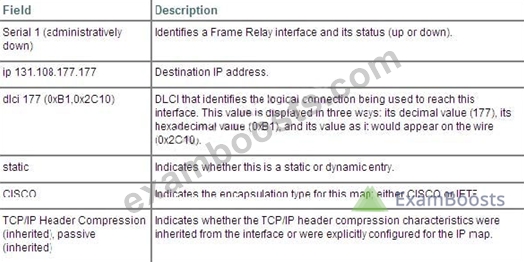
NEW QUESTION # 35
An ecommerce brand needs to determine if additional placements will drive more results than focusing the budget primarily on Facebook Feed.
A/B test results:
* Campaign 1: Facebook Feed
* Cost per purchase: S5
* Campaign 2: Four placements
* Cost per purchase: S3
* Facebook News Feed cost per purchase: $1.50
* Instagram feed cost per purchase: $2.50
* Messenger cost per purchase: $6
* Instagram Stories cost per purchase: $7
Which action should the brand take?
- A. Deliver budget to Facebook News Feed within each Ad Set
- B. Deliver budget to only Facebook News Feed and Instagram feed within each Ad Set
- C. Deliver budget against Facebook News Feed, Instagram feed, Messenger, and Instagram Stories within each ad set
- D. Remove Messenger and Instagram Stories from the test campaign and retest with two new placements: Facebook News Feed and Instagram feed
Answer: B
NEW QUESTION # 36 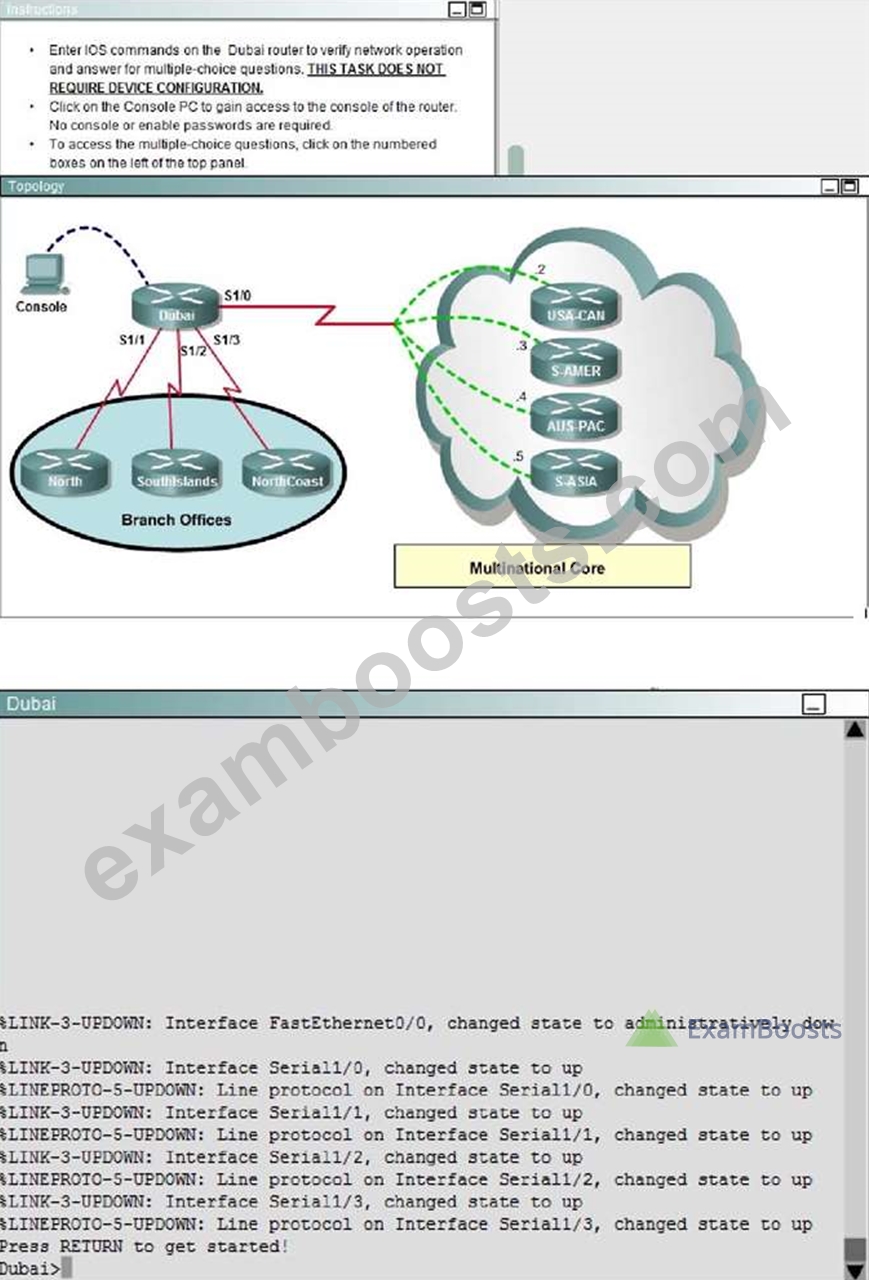
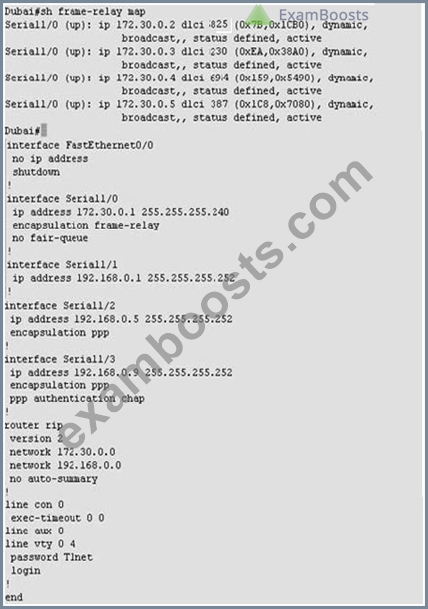
A static map to the S-AMER location is required. Which command should be used to create this map?
- A. frame-relay map ip 172.30.0.3 825 broadcast
- B. frame-relay map ip 172.30.0.3 230 broadcast
- C. frame-relay map ip 172.30.0.3 387 broadcast
- D. frame-relay map ip 172.30.0.3 694 broadcast
Answer: B
NEW QUESTION # 37
Which two statements describe the process identifier that is used in the command to configure OSPF on a router? (Choose two.)
Router(config)# router ospf 1
- A. Only one process number can be used on the same router.
- B. Different process identifiers can be used to run multiple OSPF processes
- C. All OSPF routers in an area must have the same process ID.
- D. The process number can be any number from 1 to 65,535.
- E. Hello packets are sent to each neighbor to determine the processor identifier.
Answer: B,D
NEW QUESTION # 38 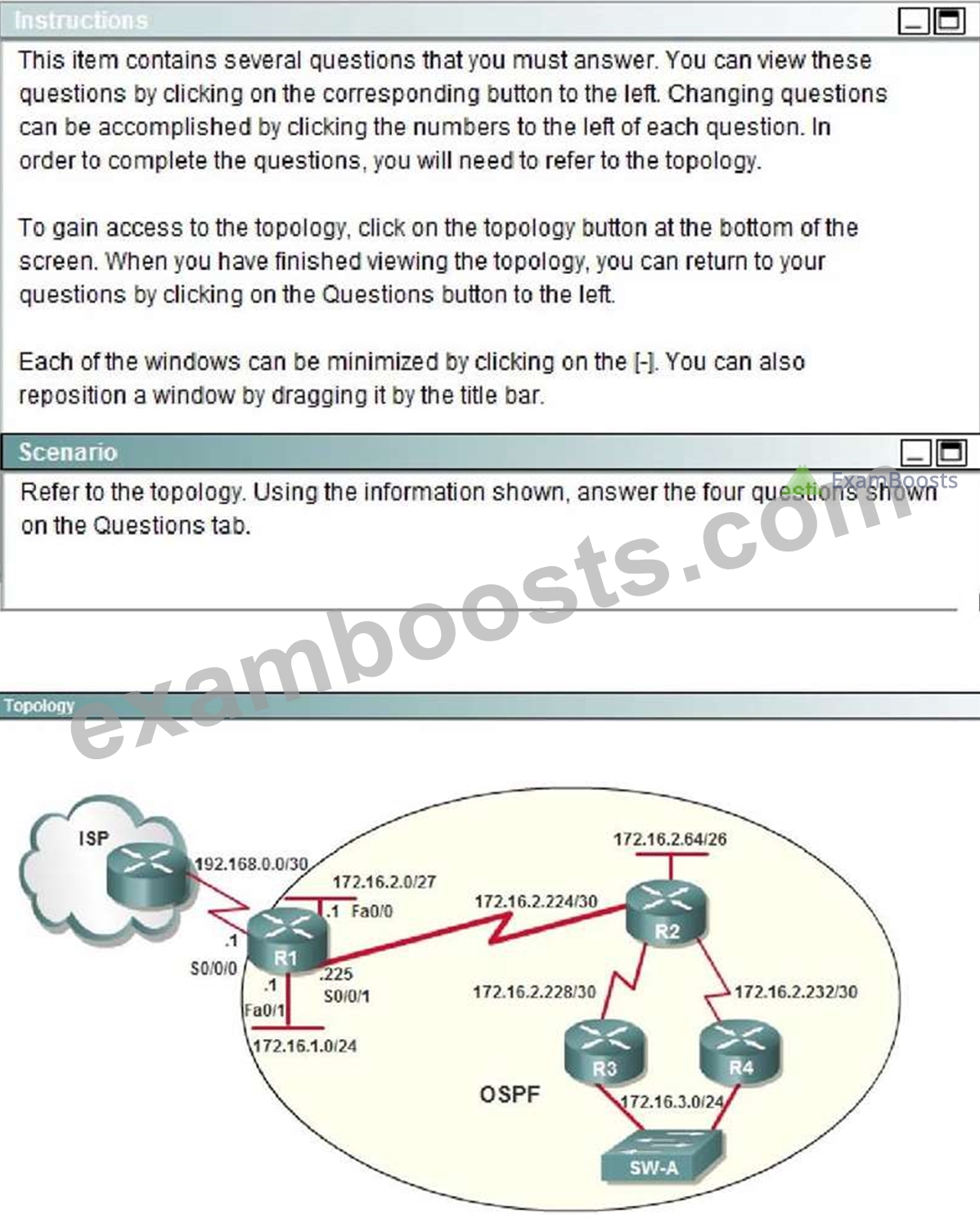
R1 is configured with the default configuration of OSPF.
From the following list of IP addresses configured on R1, which address will the OSPF process select as the router ID?
- A. 172.16.2.225
- B. 172.16.2.1
- C. 172.16.1.1
- D. 192.168.0.1
Answer: D
Explanation:
Explanation
The Router ID (RID) is an IP address used to identify the router and is chosen using the following sequence:
+
The highest IP address assigned to a loopback (logical) interface.
+
If a loopback interface is not defined, the highest IP address of all active router's physical interfaces will be chosen.
+
The router ID can be manually assigned
In this case, because a loopback interface is not configured so the highest active IP address 192.168.0.1 is chosen as the router ID.
NEW QUESTION # 39
A brand plans to run a one-month multi-cell Conversion Lift test on Facebook. The cells are designed to help the brand understand experimentally whether its current creative strategy works for different business goals. The different targets are as follows:
* Prospective audience
* Retargeting audience
What should the analyst recommend pursuing after the test?
- A. Continue with the creative strategy for all cells with positive conversion lift
- B. Continue with the creative strategy for all cells with positive statistically significant conversion lift
- C. Continue with the creative strategy for the cell with the highest positive conversion lift
- D. Continue with the creative strategy for the cell with the highest positive statistically significant conversion lift
Answer: B
NEW QUESTION # 40
What information does a router running a link-state protocol use to build and maintain its topological database? (Choose two.)
- A. LSAs from other routers
- B. SAP messages sent by other routers
- C. beacons received on point-to-point links
- D. hello packets
- E. routing tables received from other link-state routers
- F. TTL packets from designated routers
Answer: A,D
Explanation:
Link State Routing Protocols
http://www.ciscopress.com/articles/article.asp?p=24090&seqNum=4
Link state protocols, sometimes called shortest path first or distributed database protocols, are
built around a well-known algorithm from graph theory, E. W. Dijkstra'a shortest path algorithm.
Examples of link state routing protocols are:
Open Shortest Path First (OSPF) for IP
The ISO's Intermediate System to Intermediate System (IS-IS) for CLNS and IP
DEC's DNA Phase V
Novell's NetWare Link Services Protocol (NLSP)
Although link state protocols are rightly considered more complex than distance vector protocols,
the basic functionality is not complex at all:
1.Each router establishes a relationship-an adjacency-with each of its neighbors.
2.Each router sends link state advertisements (LSAs), some
3.Each router stores a copy of all the LSAs it has seen in a database. If all works well, the databases in all routers should be identical.
4.The completed topological database, also called the link state database, describes a graph of the internetwork. Using the Dijkstra algorithm, each router calculates the shortest path to each network and enters this information into the route table. OSPF Tutorial http://www.9tut.com/ospf-routing-protocol-tutorial
NEW QUESTION # 41
What does a router do if it has no EIGRP feasible successor route to a destination network and the successor route to that destination network is in active status?
- A. It routes all traffic that is addressed to the destination network to the interface indicated in the routing table.
- B. It broadcasts Hello packets to all routers in the network to re-establish neighbor adjacencies.
- C. It sends a multicast query packet to all adjacent neighbors requesting available routing paths to the destination network.
- D. It sends a copy of its neighbor table to all adjacent routers.
Answer: C
Explanation:
Introduction to EIGRP Reference:
http://www.cisco.com/en/US/tech/tk365/technologies_tech_note09186a0080093f07.shtml
Explanation:
Feasible Successors
A destination entry is moved from the topology table to the routing table when there is a feasible successor. All minimum cost paths to the destination form a set. From this set, the neighbors that have an advertised metric less than the current routing table metric are considered feasible successors.
Feasible successors are viewed by a router as neighbors that are downstream with respect to the destination.
These neighbors and the associated metrics are placed in the forwarding table.
When a neighbor changes the metric it has been advertising or a topology change occurs in the network, the set of feasible successors may have to be re-evaluated. However, this is not categorized as a route recomputation.
Route States
A topology table entry for a destination can have one of two states. A route is considered in the Passive state when a router is not performing a route recomputation. The route is in Active state when a router is undergoing a route recomputation. If there are always feasible successors, a route never has to go into Active state and avoids a route recomputation.
When there are no feasible successors, a route goes into Active state and a route recomputation occurs. A route recomputation commences with a router sending a query packet to all neighbors.
Neighboring routers can either reply if they have feasible successors for the destination or optionally return a query indicating that they are performing a route recomputation. While in Active state, a router cannot change the next-hop neighbor it is using to forward packets. Once all replies are received for a given query, the destination can transition to Passive state and a new successor can be selected.
When a link to a neighbor that is the only feasible successor goes down, all routes through that neighbor commence a route recomputation and enter the Active state.
NEW QUESTION # 42
Refer to the exhibit.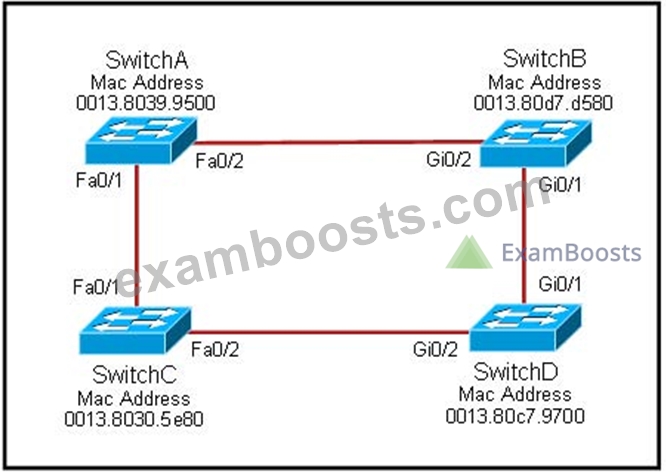
Each of these four switches has been configured with a hostname, as well as being configured to run RSTP. No other configuration changes have been made. Which three of these show the correct RSTP port roles for the indicated switches and interfaces? (Choose three.)
- A. SwitchC, Fa0/2, root
- B. SwitchB, Gi0/1, designated
- C. SwitchA, Fa0/2, designated
- D. SwitchB, Gi0/2, root
- E. SwitchD, Gi0/2, root
- F. SwitchA, Fa0/1, root
Answer: C,E,F
NEW QUESTION # 43
Refer to the exhibit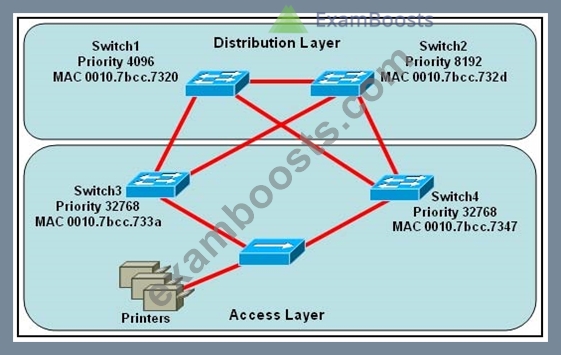
.
Which switch provides the spanning-tree designated port role for the network segment that services the printers?
- A. Switch2
- B. Switch1
- C. Switch4
- D. Switch3
Answer: D
Explanation:
First, the question asks what switch services the printers, so it can be Switch 3 or Switch 4 which is connected directly to the Printers. Designated port is a port that is in the forwarding state. All ports of the root bridge are designated ports. Switch 3 and Switch 4 has same priority so it will see on lowest MAC address and here switch 3 has lowest MAC address. So switch 3 segment will play a Designated port role. By comparing the MAC address of Switch 3 and Switch 4 we found that the MAC of Switch 3 is smaller. Therefore the interface connected to the Printers of Switch 3 will become designated interface and the interface of Switch 4 will be blocked.
NEW QUESTION # 44
What Cisco IOS feature can be enabled to pinpoint an application that is causing slow network performance?
- A. Netflow
- B. SNMP
- C. WCCP
- D. IP SLA
Answer: A
NEW QUESTION # 45
DRAG DROP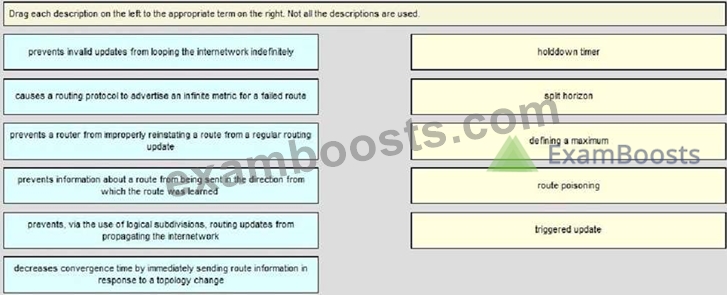
Answer:
Explanation: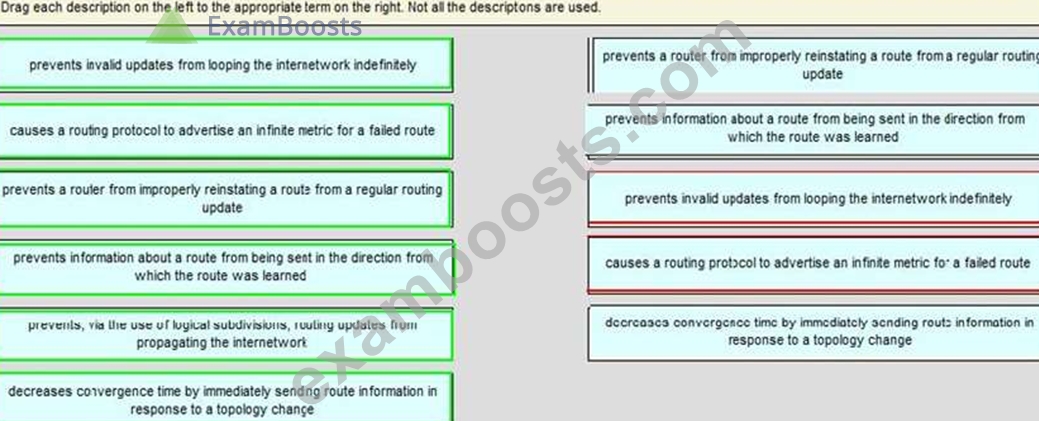
Explanation:
Reference: http://www.9tut.net/icnd2/icnd2-drag-and-drop-questions-2
+
holddown timer: prevents a router from improperly reinstating a route from a regular routing update
+
split horizon: prevents information about a route from being sent in the direction from which the route was learned
+
defining a maximum: prevents invalid updates from looping the internetwork indefinitely
+
route poisoning: causes a routing protocol to advertise an infinite metric for a failed route
+
triggered update: decreases convergence time by immediately sending route information in response to a topology change
NEW QUESTION # 46
The internetwork infrastructure of company XYZ consists of a single OSPF area as shown in the graphic. There is concern that a lack of router resources is impeding internetwork performance. As part of examining the router resources, the OSPF DRs need to be known. All the router OSPF priorities are at the default and the router IDs are shown with each router.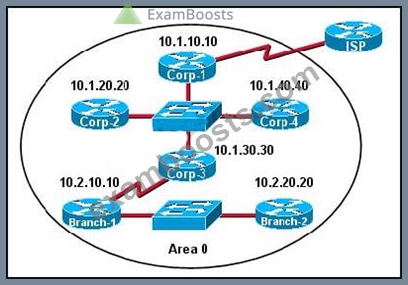
Which routers are likely to have been elected as DR? (Choose two.)
- A. Branch-2
- B. Corp-3
- C. Corp-4
- D. Branch-1
- E. Corp-2
- F. Corp-1
Answer: A,C
Explanation:
There are 2 segments on the topology above which are separated by Corp-3 router.
Each segment will have a DR so we have 2 DRs.
To select which router will become DR they will compare their router-IDs. The router with highest
(best) router-ID will become DR. The router-ID is chosen in the order below:
The highest IP address assigned to a loopback (logical) interface.
If a loopback interface is not defined, the highest IP address of all active router's physical
interfaces will be chosen.
In this question, the IP addresses of loopback interfaces are not mentioned so we will consider IP
addresses of all active router's physical interfaces. Router Corp-4 (10.1.40.40) & Branch-2
(10.2.20.20) have highest "active" IP addresses so they will become DRs.
NEW QUESTION # 47
Which parameter or parameters are used to calculate OSPF cost in Cisco routers?
- A. Bandwidth, MTU, Reliability, Delay, and Load
- B. Bandwidth and Delay
- C. Bandwidth, Delay, and MTU
- D. Bandwidth
Answer: D
NEW QUESTION # 48
Refer to the exhibit.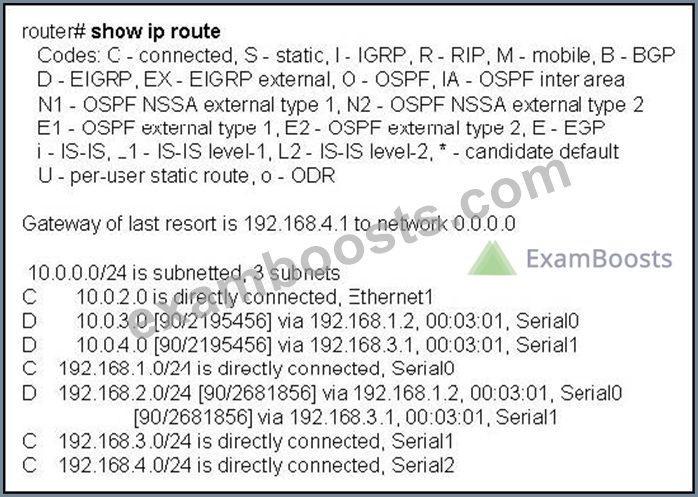
How will the router handle a packet destined for 192.0.2.156?
- A. The router will forward the packet via either Serial0 or Serial1.
- B. The router will drop the packet.
- C. The router will return the packet to its source.
- D. The router will forward the packet via Serial2.
Answer: D
NEW QUESTION # 49
Users have been complaining that their Frame Relay connection to the corporate site is very slow. The network administrator suspects that the link is overloaded. Based on the partial output of the Router # show frame relay pvc command shown in the graphic, which output value indicates to the local router that traffic sent to the corporate site is experiencing congestion?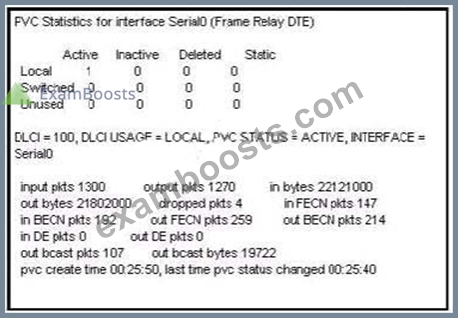
- A. DLCI=100
- B. last time PVC status changed 00:25:40
- C. in BECN packets 192
- D. in DF packets 0
- E. in FECN packets 147
Answer: C
Explanation:
First we should grasp the concept of BECN & FECN through an example: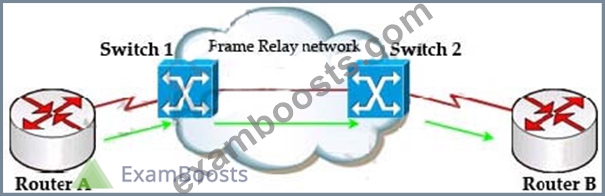
Suppose Router A wants to send data to Router B through a Frame Relay network. If the network is congested, Switch 1 (a DCE device) will set the FECN bit value of that frame to 1, indicating that frame experienced congestion in the path from source to destination. This frame is forwarded to Switch 2 and to Router B (with the FECN bit = 1). Switch 1 knows that the network is congesting so it also sends frames back to Router A with BECN bit set to 1 to inform that path through the network is congested.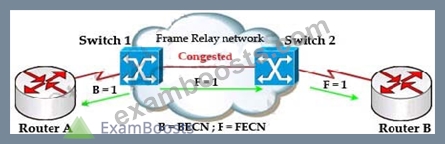
In general, BECN is used on frames traveling away from the congested area to warn source devices that congestion has occurred on that path while FECN is used to alert receiving devices if the frame experiences congestion.
BECN also informs the transmitting devices to slow down the traffic a bit until the network returns to normal state. The question asks "which output value indicates to the local router that traffic sent to the corporate site is experiencing congestion" which means it asks about the returned parameter which indicates congestion ->BECN.
NEW QUESTION # 50
A local retailer wants to measure the effectiveness of Facebook campaigns based on the number of in-store purchases after customers have been exposed to an ad within the platform.
Where should outcome data be sourced?
- A. Coordinates from each of its regional shops
- B. Third-party data sources as an estimation of real customers
- C. Data from the Facebook pixel in its site
- D. First-party data such as email or phone number captured in-store
Answer: C
NEW QUESTION # 51
......
Get 100% Real Free Marketing Science Professional 200-101 Sample Questions: https://www.examboosts.com/Facebook/200-101-practice-exam-dumps.html