

Guaranteed Success in Pega Decisioning Consultant PEGACPDC88V1 Exam Dumps
Pegasystems PEGACPDC88V1 Daily Practice Exam New 2023 Updated 60 Questions
NEW QUESTION # 14
U+ Bank, a retail bank, is cross-selling on the web by showing various credit card offers to its customers.
The bank wants to introduce a new offer in the Business Operations Environment. Place the steps in the correct order of implementation.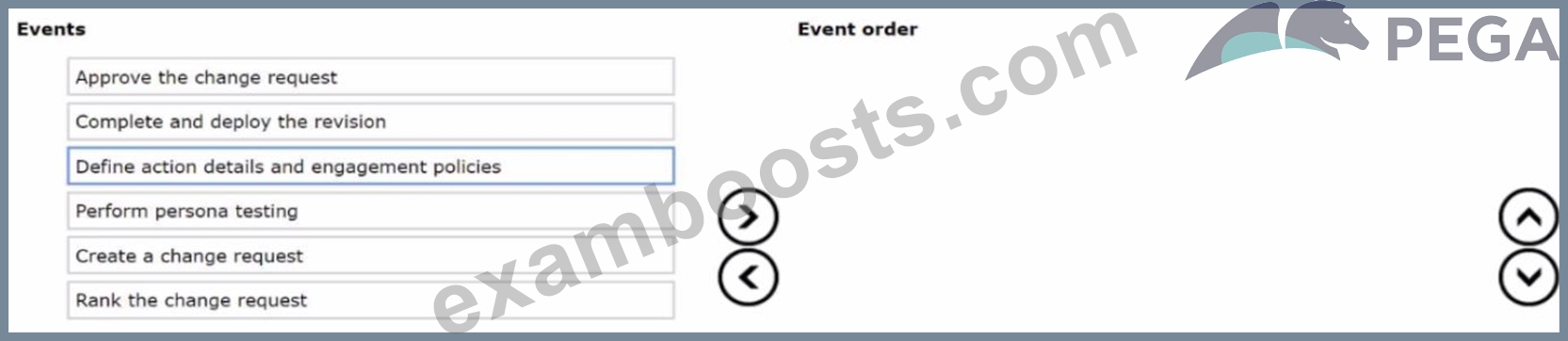
Answer:
Explanation:
1 - Create a change request
2 - Rank the change request
3 - Define action details and engagement policies
4 - Perform persona testing
5 - Approve the change request
6 - Complete and deploy the revision
NEW QUESTION # 15
U+ Bank, a retail bank, has purchased Pega Customer Decision Hub. The bank currently uses an external tool to design email content and a third-party email service provider to send emails to its customers.
As a decisioning architect, how do you recommend the bank implements this requirement?
- A. Create an internal email treatment and use Customer Decision Hub to design the email.
- B. Create an external email treatment and use an external tool to design the email.
- C. Create an internal email treatment and import the email content HTML.
- D. Create an external email treatment and use Customer Decision Hub to design the email.
Answer: B
Explanation:
To implement this requirement, you need to create an external email treatment and use an external tool to design the email. An external email treatment is a type of treatment that allows you to use a third-party email service provider to send emails to your customers. You can configure the external email treatment with the name of the provider, the authentication details, and the template ID that corresponds to the email content that you design using an external tool. This way, you can leverage your existing tools and processes for sending emails, while still using Customer Decision Hub to select the best actions and treatments for your customers. Verified Reference: Pega Academy - Decisioning Consultant - Creating external treatments
NEW QUESTION # 16
MyCo, a telecom company, uses Pega Customer Decision Hub™ to present offers to qualified customers. The business recently decided to send offer messages through the email channel. The Design department has designed an email treatment which includes dynamic placeholders.
As a deaccessioning architect, what do you use in order to test the visualization and the rendering of the email content, including replacing of the placeholders with customer information?
- A. A seed list from the Test email tab
- B. Schedule an outbound run with a limited number of customers
- C. Preview section from the email content editor
- D. A list of customer email addresses from the Test email tab
Answer: A
Explanation:
To test the visualization and the rendering of the email content, including replacing of the placeholders with customer information, you use a seed list from the Test email tab. A seed list is a predefined set of customers that you can use to test your email treatments before sending them to your target audience. You can select one or more customers from the seed list and send them a test email with your treatment. You can then verify how the email looks in their inbox and how the placeholders are replaced with their actual values. Verified Reference: [Pega Academy - Decisioning Consultant - Testing email treatments]
NEW QUESTION # 17
A decisioning architect wants to use the customer properties income and age in a Filter component. Which decision component is required to enable access to these properties?
- A. None, properties are available
- B. Proposition Data
- C. Set Property
- D. Data Import
Answer: D
Explanation:
To enable access to customer properties in a Filter component, you need to use a Data Import component. A Data Import component allows you to read data from various sources, such as data sets, data pages, or data flows, and make it available for other components in the strategy. In this case, you need to use a Data Import component that reads from a customer data source that contains income and age properties. Verified Reference: Pega Academy - Decisioning Consultant - Importing data
NEW QUESTION # 18
In a decision strategy, you can use aggregation components to____________.
- A. filter actions based on priority and relevance
- B. make calculations based upon a list of actions
- C. set a text value to a strategy property
- D. choose between actions
Answer: B
Explanation:
Aggregation components are used to perform calculations on a list of actions, such as sum, average, count, minimum, or maximum. For example, you can use an aggregation component to calculate the total value of all the actions in a group. Verified Reference: Pega Academy - Decisioning Consultant - Aggregating actions
NEW QUESTION # 19
U+ Bank, a retail bank, has recently implemented a project in which credit card offers are presented to qualified customers when they log in to the web self-service portal. The bank added engagement policy conditions to show the offers based on the bank's requirements.
In the Answer Area, select the correct engagement policy for each condition.
Answer:
Explanation:
NEW QUESTION # 20
Which of the following reasons explains why a customer might receive an action that they already accepted?
- A. The actions are filtered based on eligibility.
- B. The action suitability conditions are not defined.
- C. The suppression rules are not defined to exclude previously accepted actions.
- D. The volume constraint is not set to exclude previously accepted offers.
Answer: D
Explanation:
A customer might receive an action that they already accepted if the volume constraint for that action is not configured to exclude previously accepted offers. This option can be enabled by selecting the Exclude previously accepted actions checkbox in the volume constraint configuration. The action suitability conditions are used to determine whether an action is suitable for a customer based on their propensity, priority, or other criteria, not based on their previous responses. The suppression rules are used to exclude customers from receiving an action based on certain conditions, such as opt-out preferences or recent purchases, not based on their previous responses. The actions are filtered based on eligibility before applying the volume constraints, so this option does not explain why a customer might receive an action that they already accepted. Verified Reference: Certified Pega Decisioning Consultant | Pega Academy, Volume constraints
NEW QUESTION # 21
U+ Bank has recently defined two contact policies:
1. Suppress a group of credit card offers for 30 days if any credit card offer is rejected three times in any channel in the past 15 days.
2. Suppress the Reward card offer, part of the credit card group, for 7 days if it is rejected twice in any channel in the last 7 days. Paul, an existing U+ Bank customer, no longer sees the Reward card offer. What is the reason that Paul cannot see the offer?
- A. Paul rejected other credit card offers once on the web channel and once in the contact center.
- B. Paul rejected other credit card offers twice on the web channel and once in contact center.
- C. Paul rejected the Reward card offer once on the web channel.
- D. Paul rejected the Reward card offer once in contact center.
Answer: B
Explanation:
Paul cannot see the Reward card offer because he rejected other credit card offers twice on the web channel and once in contact center in the past 15 days. This triggers the first contact policy that suppresses a group of credit card offers for 30 days if any credit card offer is rejected three times in any channel in the past 15 days. The Reward card offer is part of the credit card group, so it is suppressed for Paul for 30 days. The second contact policy that suppresses the Reward card offer for 7 days if it is rejected twice in any channel in the last 7 days does not apply because Paul did not reject the Reward card offer twice in any channel in the last 7 days. Verified Reference: [Certified Pega Decisioning Consultant | Pega Academy], Suppression policies system Following is the description of the image that was sent with question no:5:
This is a screenshot of a table with four columns and two rows.
The table has a header row with white text on a blue background.
The header row reads "Constraint name", "Constraint mode", "Constraint value", and "Channel".
The second row has black text on a white background.
The second row reads "Standard card", "Return any action that does not exceed", "100", and "Daily".
The table has a gray border and a light blue background.
NEW QUESTION # 22
U+ Bank decides to introduce a credit cards group by leveraging the Next-Best-Action capability of Pega Customer Decision Hub™. The bank wants to present the credit card offers through inbound and outbound channels based on the following criteria:
1. Customers must be above the age of 18 to qualify for credit card offers.
2. The site offers credit cards only if customers do not explicitly opt-out of any direct marketing for credit cards.
3. The Platinum Card, one of the credit card offers, is suitable for customers with debt-to-income ratio < 45.
As a decisioning architect, how do you implement this requirement? In the Answer Area, select the correct engagement policy for each criterion.
Answer:
Explanation:
NEW QUESTION # 23
U+ Bank follows all engagement policy best practices to present credit card offers on their website. The bank has introduced a new credit card offer, the Rewards card. Anna, an existing customer, currently holds a higher value card, Premier Rewards, and does not see the new Rewards card offer.
What condition possibly prevents Anna from seeing the new Rewards card offer?
- A. Eligibility
- B. Suppression rules
- C. Applicability
- D. Suitability
Answer: B
Explanation:
Suppression rules are used to prevent customers from seeing offers that are not relevant or appropriate for them. For example, if a customer already has a higher value card, they should not see a lower value card offer. Therefore, suppression rules are the most likely condition that prevents Anna from seeing the new Rewards card offer. Verified Reference: [Pega Decisioning Consultant | Pega Academy]
NEW QUESTION # 24
A volume constraint uses the Return any action that does not exceed constraint mode. The following tables show the configuration of the volume constraints and the list of customers in the outbound segment:
The outbound run selects customers in the following order to apply the volume constraints: CUST-01, CUST-02, CUST-03, and CUST-05.
Based on the configuration of the volume constraints for each channel, which offer does CUST-05 receive?
- A. Silver card and Diamond card
- B. Silver card
- C. None
- D. Diamond card
Answer: D
Explanation:
CUST-05 receives the Diamond card offer because it is the only action that does not exceed the volume constraint for the email channel. The Silver card offer has already reached its limit of 2 emails per day, so it is not eligible for CUST-05. The volume constraint mode Return any action that does not exceed means that any action that meets the eligibility and suitability criteria and does not violate the volume constraint will be returned, even if there are other actions with higher priority or propensity. Verified Reference: Certified Pega Decisioning Consultant | Pega Academy, Volume constraints
NEW QUESTION # 25
A financial institution has created a new policy that states the company will not send more than 500 emails per day. Which option allows you to implement the requirement?
- A. Outbound channel limits
- B. Applicability rules
- C. Volume constraints
- D. Suppression rules
Answer: C
Explanation:
Volume constraints allow you to limit the number of times an action is presented to customers across one or more channels. You can use volume constraints to implement a policy that restricts the number of emails sent per day. Outbound channel limits are used to limit the number of customers contacted per channel per run, not per day. Suppression rules are used to exclude customers from receiving an action based on certain conditions, such as opt-out preferences or recent purchases. Applicability rules are used to determine whether an action is relevant for a customer based on their profile or context, not based on the number of times the action is presented. Verified Reference: Certified Pega Decisioning Consultant | Pega Academy, Volume constraints
NEW QUESTION # 26
U+ Bank wants to use Pega Customer Decision Hub™ to display a credit card offer, the Standard Card, to every customer who logs in to the bank website. What three of the following artifacts are mandatory to implement this requirement7 (Choose Three)
- A. Customer engagement policies.
- B. Real-time containers.
- C. An action and the associated web treatment.
- D. Customer contact policies.
- E. A business structure.
Answer: B,C,E
Explanation:
To implement this requirement, you need to create an action and the associated web treatment, a real-time container, and a business structure. An action is a proposition that you want to present to a customer, such as a credit card offer. A treatment is the way you present the action to a customer, such as an image or a text message. A real-time container is a configuration that defines how to deliver actions and treatments to a specific channel, such as a website or a mobile app. A business structure is a hierarchy of business groups and business issues that organizes actions into meaningful categories. Verified Reference: Pega Academy - Decisioning Consultant - Creating actions and treatments, Pega Academy - Decisioning Consultant - Configuring real-time containers, [Pega Academy - Decisioning Consultant - Defining business structure]
NEW QUESTION # 27
The following decision strategy outputs the most profitable shoe a retailer can sell. The profit is the selling Prices of the shoe, minus the Cost to acquire the shoe.
The details of the shoes are provided in the following table:
The details of the shoes are provided in the following table:
To output the most profitable shoe, which component do you add in the blank space that is highlighted in red?
- A. Prioritize
- B. Filter
- C. Group By
- D. Decision table
Answer: A
Explanation:
To output the most profitable shoe, you need to add a Prioritize component in the blank space. A Prioritize component allows you to rank actions based on one or more properties. In this case, you can rank the shoes based on the Profit property and select the highest ranked shoe as the output. Verified Reference: Pega Academy - Decisioning Consultant - Prioritizing actions
NEW QUESTION # 28
U+ Bank has decided to use the Pega Customer Decision Hub, M to recommend more relevant banner ads to its customers when they visit the personal portal. Select each placement type on the left and drag it to the correct requirement on the right.
Answer:
Explanation:
NEW QUESTION # 29
The U+ Bank marketing department wants to leverage the next-best-action capability of Pega Customer Decision Hub™ on its website to promote new offers to each customer.
Answer:
Explanation:
1 - The website invokes the real-time container before loading the account page.
2 - Customer Decision Hub evaluates offers form the associated issue/group.
3 - Customer Decision Hub returns the resulting offer details to the website.
4 - The website loads the account page with the content returned by Customer Decision Hub.
NEW QUESTION # 30
As a decisioning architect, you advise the board on the business issues for which they must use the Next-Best-Action strategy. Which three business issues do you recommend? (Choose Three)
- A. Service
- B. Accounting
- C. Resource Planning
- D. Retention
- E. Collections
Answer: A,D,E
Explanation:
The Next-Best-Action strategy is a customer-centric approach that aims to deliver the most relevant and valuable proposition for each customer at any given moment. You can use the Next-Best-Action strategy to address various business issues that involve customer interactions, such as service, retention, and collections. Service is the process of providing assistance and support to customers who have questions or problems. Retention is the process of preventing customers from leaving or switching to competitors. Collections is the process of recovering unpaid debts from customers who are delinquent or defaulting on their obligations. These are all business issues that can benefit from using the Next-Best-Action strategy. Verified Reference: [Pega Decisioning Consultant | Pega Academy]
NEW QUESTION # 31
1yCo, a telecom company, wants to start promoting data plan offers through SMS to qualified customers. The marketing team needs to ensure that the outbound run always uses the latest customer information.
What do you configure to implement this requirement?
- A. Trigger an external Extract-Transform-Load (ETL) process.
- B. Run the starting population segment daily.
- C. Select a different audience sample with a similar profile.
- D. Select the Refresh the audience checkbox.
Answer: D
Explanation:
To implement this requirement, you need to select the Refresh the audience checkbox in the outbound run configuration. This option allows you to refresh the audience data before each run by executing a data flow that reads from your customer data source and updates your customer data set. This way, you can ensure that the outbound run always uses the latest customer information available in your system. Verified Reference: Pega Academy - Decisioning Consultant - Configuring outbound runs
NEW QUESTION # 32
U+ Bank is facing an unforeseen technical issue with its customer care system. As a result, the bank wants to share the new temporary contact details with all customers over an SMS.
Which type of outbound interaction do you configure to implement this requirement?
- A. Security event
- B. Priority communication
- C. Customer event
- D. Scheduled update
Answer: B
Explanation:
A priority communication is a type of outbound interaction that allows you to send urgent messages to customers that are not related to any specific offer or proposition. You can use priority communications to inform customers about important events or changes that affect their relationship with your organization. In this case, the bank wants to share the new temporary contact details with all customers over an SMS, so creating a priority communication is the best option. Verified Reference: [Pega Decisioning Consultant | Pega Academy]
NEW QUESTION # 33
......
Test Engine to Practice PEGACPDC88V1 Test Questions: https://www.examboosts.com/Pegasystems/PEGACPDC88V1-practice-exam-dumps.html
Use Valid PEGACPDC88V1 Exam - Actual Exam Question & Answer: https://drive.google.com/open?id=128gKeGaimtNwDykJbBOCeG_txjbE84cB