

[Jun-2026 Newly Released] L5M5 Dumps for CIPS Level 5 Advanced Diploma in Procurement and Supply Certified
Updated Verified L5M5 dumps Q&As - 100% Pass
NEW QUESTION # 16
An electronics manufacturing company aims to transition to a circular economy model by minimizing waste and maximizing resource efficiency. Which strategies would best support this shift?
- A. Designing products for easy disassembly and refurbishment, allowing for longer product life and reuse of components
- B. Implementing a one-time recycling program for old devices
- C. Offering discounts on new products but not providing any take-back or recycling options for old devices
- D. Focusing solely on increasing production to meet rising consumer demand
Answer: A
Explanation:
Choice A- While a recycling program is a step in the right direction, it is a reactive approach. A circular economy emphasizes proactive strategies such as designing products for longevity and reusability, rather than just recycling at the end of a product's life.
option promotes sustainable practices by encouraging product longevity and resource recovery, making it the most aligned with circular economy principles. This approach minimizes waste by ensuring that products can be refurbished or repaired rather than discarded. It encourages a culture of reuse, which is fundamental to the circular economy model.
Choice C- This approach is contrary to the principles of a circular economy, which seeks to minimize resource extraction and waste. Increasing production often leads to more waste and environmental impact, rather than promoting sustainability and resource efficiency.
Choice D- While discounts can encourage sales, without a system to handle old devices, this option does not contribute to sustainability. It fails to address the issue of waste management and does not promote reuse or recycling, which are essential components of a circular economy.
Reference:
LO-1.1; Page 14; The role of environmental considerations in securing ethical and sustainable procurement and supply arrangements
NEW QUESTION # 17
Which organisation is responsible for the creation of the 2030 Sustainable Development Agenda?
- A. UN
- B. ILO
- C. NATO
- D. ISO
Answer: A
Explanation:
This is the UN. There are 17 sustainability goals and these are listed on p.3. For the exam it's a good idea to familiarise yourself with them, but there's no need to learn them all off-by-heart.
NEW QUESTION # 18
Red Flag Inc. introduces a new ESG policy and is considering low-cost country sourcing. They need to evaluate suppliers. Which activities should they carry out? Select THREE
- A. Conduct regular risk assessments to identify risks that may impact ESG performance
- B. Align KPIs to the ESG policy
- C. Select a supplier in their own country, as all low-cost suppliers risk using slave labour
- D. Introduce stringent performance management practices
- E. Ensure the supplier has ISO9001 and SA8000 certifications
Answer: A,B,D
Explanation:
Comprehensive and Detailed Explanation From Exact Extract of Documents:
Effective supplier evaluation must align with ESG policies. The L5M5 study guide (p.80) highlights that procurement should establish performance management frameworks (A), ensure that KPIs reflect ESG objectives (B), and carry out regular risk assessments (D). While certifications such as ISO9001 and SA8000 (C) are valuable, requiring them universally may exclude smaller, ethical suppliers unable to afford certification costs. Option E is unethical and discriminatory, as not all low-cost country suppliers use forced labour. A balanced, risk-based approach ensures ethical compliance while supporting sustainability goals.
Reference: Managing Ethical Procurement and Supply (L5M5) Study Guide, p.80
NEW QUESTION # 19
While low-cost country sourcing can provide substantial cost savings for buyers, it also comes with significant risks. Which of the following should be avoided as a potential target for low-cost country sourcing?
- A. A country that is remote geographically but with good transportation routes
- B. A country where companies use Just in Time (JIT) method of SCM
- C. A country consisting of workers with detailed knowledge of the product
- D. A country with stable tax and tariff structures
Answer: B
Explanation:
Choice B-It is important to calculate the potential cost of a supplier failing to meet the level of service timeline. If a company uses JIT methods of supply chain management, then LCCS is not a suitable option especially for critical components because delivery delays can be costly and disruptive. Without backup inventory, customers may have to wait for the company to receive supplies and manufacture the product. Thus is the correct answer.
Incorrect answer:
Choice A- A country with good transportation routes is critical to analyse as shipping will be fairly economical. Therefore is a potential target for LCCS.
Choice C- Level of education and skills of workers in chosen low cost country will help in producing vital key components as they will specialize in them. Thus this country should be a potential target of LCCS.
Choice D- Tariffs and taxes can significantly impact the cost-effectiveness of sourcing from low-cost countries. Understanding the export taxation in the source country and import tariffs in one's own country is crucial. This being stable can help in calculating and making a decision of selecting a country for low cost sourcing.
Reference:
LO-1.2; Page 76; Low-cost country sourcing
NEW QUESTION # 20
A Fair Trade-certified coffee cooperative located in a rural area is undergoing an audit to assess its compliance with Fair Trade standards. During the audit, several non-compliance issues are identified, requiring immediate corrective action to align with International Labour Organization (ILO) standards.
For each identified breach, match the corresponding Fair Trade Principle with the most relevant ILO Standard by selecting the appropriate option and placing it in the table below.
Breach 1: Workers in the coffee processing plant are exposed to prolonged noise levels during their shifts. However, many employees do not have or are not using proper hearing protection, raising serious concerns about potential hearing damage.
Breach 2: A significant number of workers, particularly local laborers, receive wages below the living wage threshold. This has resulted in financial hardship for their families, despite the cooperative's Fair Trade certification.
Breach 3: The cooperative is engaged in environmentally harmful waste disposal practices, frequently dumping waste into nearby streams. This has led to increasing concerns among local communities and environmental advocacy groups regarding the negative impact on the local ecosystem.
Breach 4: The cooperative exhibits gender-based employment disparities, where women are not appointed to certain roles, particularly managerial and supervisory positions. Additionally, the required uniforms for these roles fail to accommodate women, further restricting their opportunities due to health and safety regulations.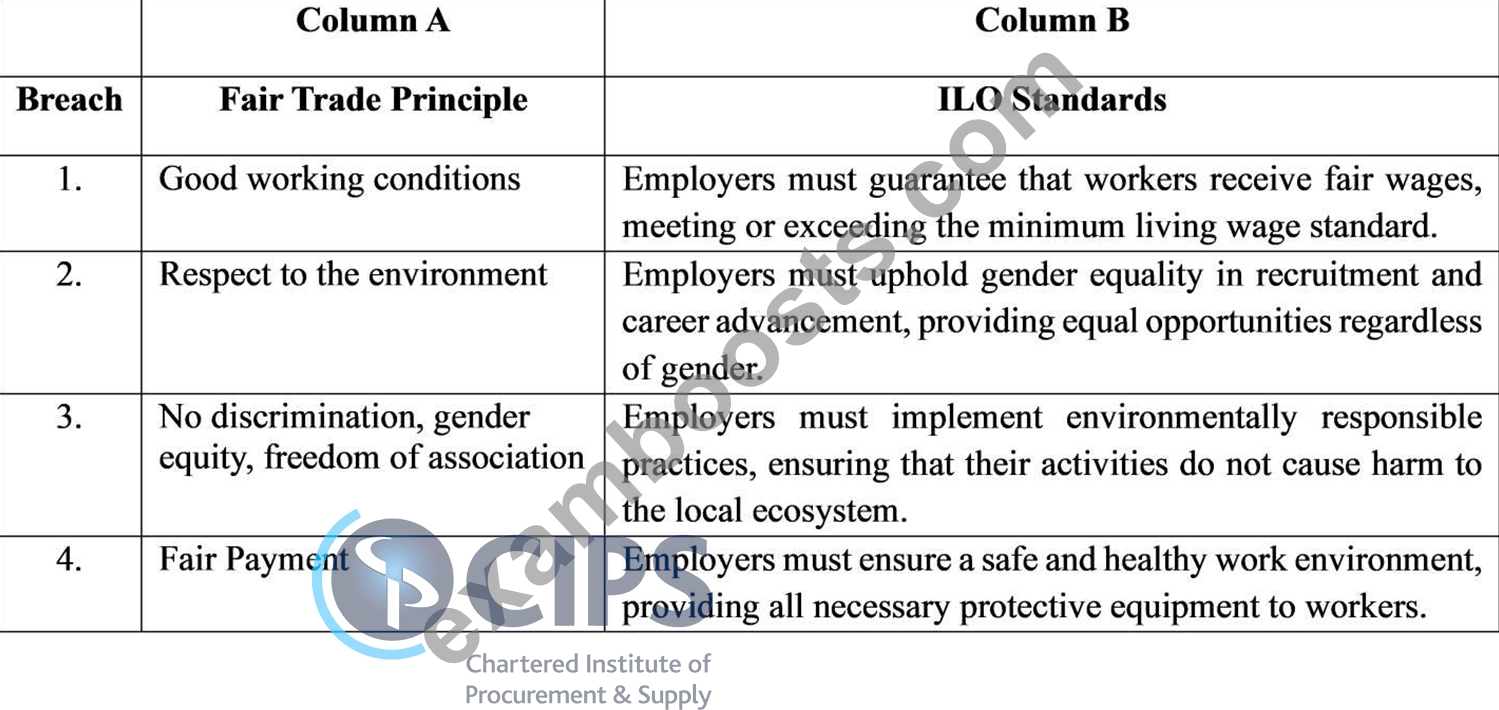
- A. Fair Payment: Workers must receive fair wages that meet the minimum living wage requirements.
- B. No discrimination, gender equity, freedom of association: Employers must ensure gender equality in hiring practices and provide equal opportunities for all workers, regardless of gender.
- C. Good working conditions: Workers must be provided with a safe working environment that meets all health and safety standards, including protective equipment
- D. Respect to the environment: Employers must adopt practices that reduce environmental impact and ensure that the working environment does not harm the local ecosystem
Answer: A,B,C,D
Explanation: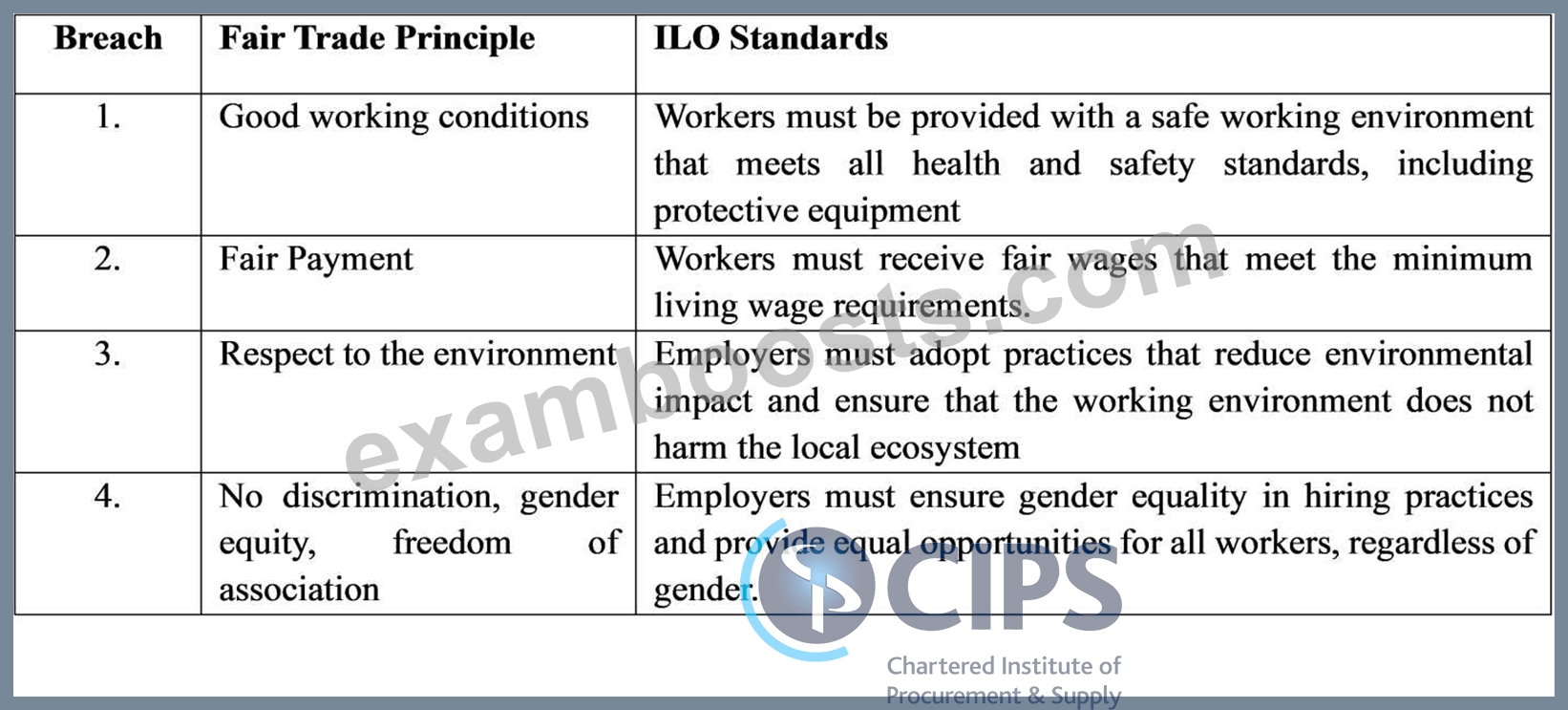
Good Working Conditions → A) Workers must be provided with a safe working environment that meets all health and safety standards, including protective equipment. The Fair-Trade principle of good working conditions emphasizes that workers should have access to a safe, healthy, and supportive work environment. ILO Principle A aligns with this by requiring safety measures such as protective equipment to ensure worker well-being. Fair Payment → C) Workers must receive fair wages that meet the minimum living wage requirements.
NEW QUESTION # 21
Ruben is buying new machinery for his factory. He chooses a more expensive option after considering ESG factors. Why might this be?
- A. The more expensive item will be more environmentally friendly
- B. The higher-priced item is from a more reputable company
- C. In terms of life-cycle costing, the more expensive item may be cheaper in the long term
- D. The higher-priced item will be of better quality
Answer: C
Explanation:
Comprehensive and Detailed Explanation From Exact Extract of Documents:
Procurement often considers Whole Life Cycle Costing (WLCC) rather than upfront cost alone. The L5M5 study guide (p.7) explains that while a product may be more expensive initially, it may be cheaper in the long term due to lower maintenance costs, greater durability, and reduced energy use. This approach supports sustainability by balancing financial and environmental impacts. Options A, B, and D cannot be assumed from the scenario since no evidence supports them. WLCC ensures procurement delivers long-term value, aligning with sustainability goals.
Reference: Managing Ethical Procurement and Supply (L5M5) Study Guide, p.7
NEW QUESTION # 22
The development of a documented process to assess the environmental performance of suppliers prior to appointment, would be covered by which part of an ISO 14001:2015 environmental management system?
- A. Context of the organization
- B. Support
- C. Operation
- D. Performance evaluation
Answer: C
Explanation:
Choice B- This is the correct answer. The "Operation" clause of ISO 14001:2015 includes the need for an organization to establish processes for managing external impacts, such as assessing the environmental performance of suppliers and considering their sustainability efforts before appointing them.
Incorrect answer:
Choice A- This part of the ISO 14001:2015 focuses on monitoring, measuring, analyzing, and evaluating the environmental performance of the organization. It is more about assessing the internal processes rather than supplier assessment.
Choice C- This part focuses on understanding the external and internal factors that influence the organization's environmental management system, but not directly on supplier assessment processes.
Choice D- This section covers the resources, competence, awareness, communication, and documented information needed to support the environmental management system, but does not directly address the supplier evaluation process.
Reference:
LO-3.2; Page 284; Role of industry standards and frameworks used by organizations in securing ESG considerations and ethical standards
NEW QUESTION # 23
All of the following are advantages of low-cost country sourcing EXCEPT which one?
- A. Intellectual property is easily protected
- B. A wider array of potential suppliers are available
- C. Access to new and better process technologies
- D. Lower wage rates allow lower manufacturing costs
Answer: A
Explanation:
Choice B - LCCS carries the risk of engaging with unethical suppliers, raising concerns about the protection of intellectual property. Consequently, this serves as the answer.
Incorrect answer:
Choice A - This is an advantage of LCCS as LCCS opens up opportunities to engage potential suppliers globally.
Choice C - Companies use LCCS to find more affordable raw materials, labor and manufacturing thereby increasing profits.
Choice D- When considering the profitability of LCCS, a procurement professional will consider the development in technologies have made it easier for their business to communicate with and source from suppliers in low cost countries. This means business can source more affordable products.
Reference:
LO-1.4; Page 106-107; Profit maximization and low-cost sourcing
NEW QUESTION # 24
Supply forecasting investigates the company's demand for an item, including current and projected demand categorised by industry and product end use. Is this statement TRUE?
- A. Yes - it gathers information about supply and demand
- B. No - supply forecasting collects data about current suppliers and trends that might affect supply
- C. Yes - it is used by all companies within the supply chain
- D. No - supply forecasting provides a prediction of short and long-term prices and trends
Answer: B
Explanation:
Comprehensive and Detailed Explanation From Exact Extract of Documents:
The L5M5 study guide (old p.93, new p.114) makes a clear distinction between demand forecasting and supply forecasting. The statement given in the question is actually a definition of demand forecasting, not supply forecasting. Supply forecasting is focused on gathering data about current suppliers and external trends that may impact availability of goods and services. This can include political issues, natural disasters, or supplier financial stability. Option D instead refers to price forecasting, which is another distinct activity. Procurement professionals use supply forecasting to assess risks, build resilience, and anticipate potential disruptions in supply markets.
Reference: Managing Ethical Procurement and Supply (L5M5) Study Guide, p.114
NEW QUESTION # 25
There are many different drivers of globalisation. Which of the following would be considered a cost driver?
- A. To increase value for stakeholders
- B. Improvements in transport technology
- C. Trading rules abroad less stringent
- D. Opportunity to build economies of scale
Answer: D
Explanation:
Comprehensive and Detailed Explanation From Exact Extract of Documents:
Globalisation is driven by a variety of factors, including cost, technology, and regulation. A cost driver is a factor that helps organisations reduce expenses and achieve financial efficiency. According to the L5M5 study guide (p.56), one of the most significant cost drivers is the opportunity to build economies of scale, where larger production volumes reduce per-unit costs. While improvements in technology (A) and relaxed trade rules (C) are drivers of globalisation, they are not specifically cost-related. "Value for stakeholders" (B) is broader and not strictly a cost driver. Procurement professionals should recognise economies of scale as a primary cost incentive for international sourcing and trade.
Reference: Managing Ethical Procurement and Supply (L5M5) Study Guide, p.56
NEW QUESTION # 26
A large electronics company uses third-party audits to ensure supplier compliance with labor standards. However, one supplier has raised concerns about undergoing multiple audits from different buyers, each with varying requirements. The supplier argues that this is diverting resources from making meaningful labor condition improvements.
Which issue is most relevant to the electronics company?
- A. Hidden issues
- B. Audit fatigue
- C. Box ticking
- D. Risk of audit fraud
Answer: B
Explanation:
Option A- The supplier's complaint about being overwhelmed by repeated audits from multiple buyers aligns with the concept of audit fatigue. This issue arises when frequent and overlapping audits burden suppliers, making it harder for them to implement sustainable improvements.
Incorrect answer:
Option B- This refers to a superficial approach to compliance, where suppliers focus on meeting the minimum requirements on paper rather than making meaningful, lasting improvements in working conditions. The scenario focuses on the supplier being overwhelmed by frequent audits, not on them meeting requirements superficially.
Option C- Risk of Audit Fraud arises when suppliers deliberately falsify records, misrepresent practices, or hide non-compliance to pass audits. There's no indication in the scenario that the supplier is misrepresenting their compliance or engaging in fraudulent activities.
Option D- This refers to problems that remain undetected during audits due to ineffective audit processes or deliberate concealment by suppliers. The scenario does not mention undetected issues or gaps in identifying non-compliance; the focus is on the supplier's challenges with repeated audits.
Reference:
LO-3.1; Page 273; Labor codes of conduct: Ethical Trading Initiative (ETI) and Social Accountability International's standard SA8000
NEW QUESTION # 27
What is the primary purpose of a supplier code of conduct?
- A. To ensure suppliers take full responsibility for product quality
- B. To outline the payment terms and delivery schedules for suppliers
- C. To define the penalties for non-compliance in supplier contracts
- D. To establish the expectations and standards for supplier behavior and practices
Answer: D
Explanation:
Choice B- A supplier code of conduct sets clear guidelines on ethical, social, environmental, and legal responsibilities that suppliers are expected to follow. Therefore B is the correct answer.
Incorrect answer:
Choice A- This is not the primary purpose of a supplier code of conduct. While the code may mention consequences for non-compliance, its primary focus is on establishing ethical and operational standards rather than detailing penalties.
Choice C- Payment terms and delivery schedules are typically included in contractual agreements, not in a supplier code of conduct. The code focuses more on ethical and sustainability standards rather than logistical or financial details.
Choice D- While product quality may be a part of a supplier's responsibilities, it is usually addressed in specific quality agreements or technical specifications rather than the supplier code of conduct. The code primarily deals with broader principles such as ethical labor practices, environmental impact, and compliance with laws.
Reference:
LO-2.2; Page 184; Monitoring Contract Performance
NEW QUESTION # 28
Which of the following is NOT a reason for supply chain mapping?
- A. Gathering quality data through audits
- B. Understanding and gaining insights into suppliers
- C. Eliminating the need for supplier relationship management
- D. Identifying potential risks and vulnerabilities
Answer: C
Explanation:
Supply chain mapping aims to identify risks, improve visibility, and ensure compliance, among other benefits. However, it does not eliminate the need for managing supplier relationships; in fact, it often enhances the ability to manage those relationships effectively.
Reference:
LO-2.1; Page 155; Mapping supply chains to achieve supply chain transparency
NEW QUESTION # 29
In 1999, the UN launched the Global Compact, a principle-based framework for sustainable business. Which of the following areas are covered by the Global Compact? Select THREE
- A. Racism
- B. Minimum wage
- C. Anti-corruption
- D. Environment
- E. Human rights
Answer: C,D,E
Explanation:
Comprehensive and Detailed Explanation From Exact Extract of Documents:
The UN Global Compact is based on ten principles derived from UN declarations. According to the L5M5 study guide (p.249), the areas covered are: human rights (A), labour standards, environment (B), and anti-corruption (C). "Racism" (D) is not listed specifically; instead, the Compact addresses non-discrimination as part of labour rights. "Minimum wage" (E) is not a universal standard in the Compact, though labour standards cover fair conditions of work. Procurement professionals should align supply strategies with these principles to support global sustainability and ethical practice.
Reference: Managing Ethical Procurement and Supply (L5M5) Study Guide, p.249
NEW QUESTION # 30
Which of the following are benefits of sustainable business practices? Select TWO
- A. Competitive advantage
- B. Increased productivity and reduced waste
- C. Weakened performance
- D. Increased spending
Answer: A,B
Explanation:
Comprehensive and Detailed Explanation From Exact Extract of Documents:
The L5M5 study guide (p.7) highlights key benefits of sustainability, including increased productivity, reduced waste (A), and gaining competitive advantage (B) in the marketplace. Sustainable practices often improve efficiency, reduce resource consumption, and build stronger reputations, which attract customers and investors. Options C and D are incorrect, as weakened performance and higher spending are not benefits; instead, sustainability enhances resilience and long-term cost savings. Procurement professionals must position sustainability not as a cost burden but as a driver of efficiency, innovation, and brand strength.
Reference: Managing Ethical Procurement and Supply (L5M5) Study Guide, p.7
NEW QUESTION # 31
How do Fair Trade organisations protect producers of raw materials from poor economic conditions?
- A. A standard for working conditions is set
- B. A minimum price is set for purchase of items
- C. Final products are marketed as Fair Trade
- D. Money is provided to communal funds
Answer: B
Explanation:
Comprehensive and Detailed Explanation From Exact Extract of Documents:
Fair Trade organisations protect producers economically by ensuring a minimum price for raw materials, regardless of market fluctuations. The L5M5 study guide (old p.224, new p.303) explains that this stabilises producer incomes against volatile commodity prices, tariffs, or currency risks. While Fair Trade also involves better working conditions and community investment, the primary economic safeguard is the guaranteed minimum price. Procurement professionals should recognise how Fair Trade contributes to supply chain stability and resilience.
Reference: Managing Ethical Procurement and Supply (L5M5) Study Guide, p.303
NEW QUESTION # 32
......
Latest L5M5 Exam Dumps CIPS Exam from Training: https://www.examboosts.com/CIPS/L5M5-practice-exam-dumps.html
New 2026 Latest Questions L5M5 Dumps - Use Updated CIPS Exam: https://drive.google.com/open?id=1E1f97gYqAmFA2BSoLgtsgzQNMmcoOFXh