

Pass Exam Questions Efficiently With OGEA-103 Questions (2025)
OGEA-103 Questions - Truly Beneficial For Your The Open Group Exam
The Open Group OGEA-103 (TOGAF Enterprise Architecture Combined Part 1 and Part 2) Certification Exam is a comprehensive certification program that tests the candidate's proficiency in enterprise architecture concepts, principles, and practices. It is a globally recognized certification that provides a common language, methodology, and framework for enterprise architecture professionals. TOGAF Enterprise Architecture Combined Part 1 and Part 2 Exam certification is ideal for professionals who want to advance their careers in enterprise architecture and demonstrate their expertise to employers and clients.
NEW QUESTION # 73
Consider the following descriptions of deliverables consumed and produced across the TOGAF ADM cycle.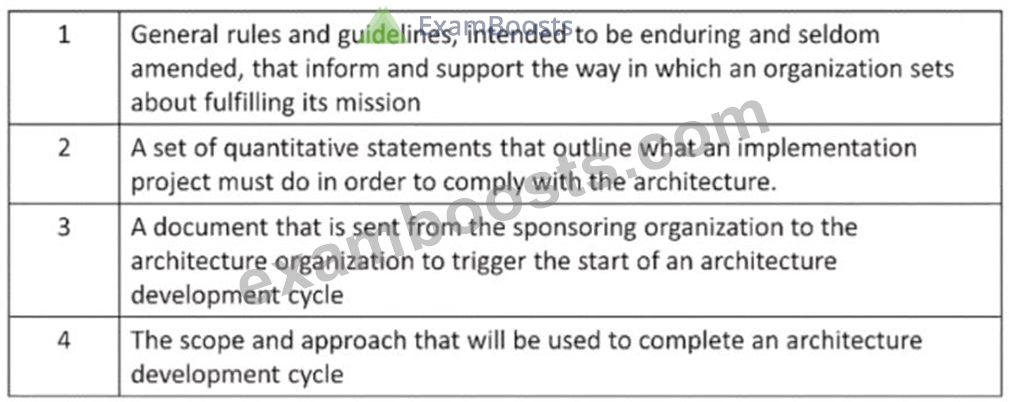
Which deliverables match these descriptions?
- A. 1 Architecture Principles - 2 Architecture Requirements Specification - 3 Request for Architecture Work
- 4 Statement of Architecture Work - B. 1 Statement of Architecture Work - 2 Architecture Principles - 3 Architecture Requirements Specification - 4 Request for Architecture Work
- C. 1 Request for Architecture Work - 2 Statement of Architecture Work - 3 Architecture Principles - 4 Architecture Requirements Specification
- D. 1 Architecture Requirements Specification - 2 Request for Architecture Work - 3 Statement of Architecture Work - 4 Architecture Principles
Answer: C
Explanation:
The Request for Architecture Work is a deliverable that is sent from the sponsor and triggers the start of an architecture development cycle. It defines the scope, budget, schedule, and deliverables for a specific architecture project. The Statement of Architecture Work is a deliverable that is produced by the architect and defines the approach and resources needed to complete an architecture project. It forms the basis of a contractual agreement between the sponsor and the architecture organization. The Architecture Principles are a deliverable that is produced by the architect and defines the general rules and guidelines for the architecture work. They reflect the business principles, business goals, and business drivers of the organization. The Architecture Requirements Specification is a deliverable that is produced by the architect and defines the requirements that govern the architecture work. It covers both functional and non-functional requirements as well as constraints and assumptions.
NEW QUESTION # 74
Exhibit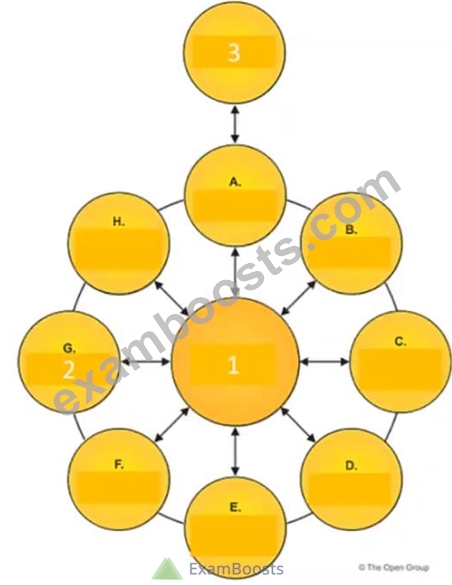
Consider the illustration showing an architecture development cycle Which description matches the phase of the ADM labeled as item 1?
- A. Conducts implementation planning for the architecture defined in previous phases
- B. Provides architectural oversight for the implementation
- C. Establishes procedures for managing change to the new architecture
- D. Operates the process of managing architecture requirements
Answer: A
Explanation:
The phase of the ADM labeled as item 1 is Phase F: Migration Planning. This phase conducts implementation planning for the architecture defined in previous phases by creating an Architecture Roadmap and a detailed Implementation and Migration Plan. This phase also identifies and groups major work packages, transition architectures, projects, and dependencies. Reference: https://pubs.opengroup.org/architecture/togaf9-doc/arch/chap19.html
NEW QUESTION # 75
Which of the following best describes the purpose of the Architecture Roadmap?
- A. It provides for effective communication of the end architecture project to the stakeholders
- B. It lists work packages on a timeline showing progress towards the Target Architecture
- C. It is sent from the sponsor and triggers the start of an architecture development cycle
- D. It forms the basis of a contractual agreement between the sponsor and the architecture organization
Answer: B
Explanation:
The purpose of the Architecture Roadmap is to provide a high-level view of how the Baseline Architecture will transition to the Target Architecture over time. It lists work packages on a timeline showing progress towards the Target Architecture, as well as dependencies, risks, and benefits. The Architecture Roadmap forms part of the Implementation and Migration Plan and guides the execution of the architecture projects.References:https://pubs.opengroup.org/architecture/togaf9-doc/arch/chap20.html
NEW QUESTION # 76
Consider the following statement.
According to the TOGAF standard, a governed approach of a particular deliverable will ensure adherence to the principles, standards, and requirements of the existing or developing architectures.
Which deliverable does this refer to?
- A. An Architecture Contract
- B. The Architecture Definition Document
- C. The Architecture Vision
- D. The Statement of Architecture Work
Answer: A
Explanation:
According to the TOGAF Standard, 10th Edition, an architecture contract is "a formal agreement between a service provider and a service consumer that defines the mutual commitments and expectations for the delivery of an architecture" 1. An architecture contract is a governed approach of aparticular deliverable that will ensure adherence to the principles, standards, and requirements of the existing or developing architectures, as it specifies the roles, responsibilities, deliverables, quality criteria, and acceptance criteria for the architecture work 1. The other options are not correct, as they are not governed approaches of a particular deliverable, but rather different types of deliverables within the architecture development process. An architecture vision is "a high-level, aspirational view of the target architecture" 1. A statement of architecture work is "a document that defines the scope and approach that will be used to complete an architecture project"
1. An architecture definition document is "a document that describes the baseline and target architectures for one or more domains" 1. References: 1: TOGAF Standard, 10th Edition, Part I: Introduction, Chapter 3:
Definitions.
NEW QUESTION # 77
Consider the illustration.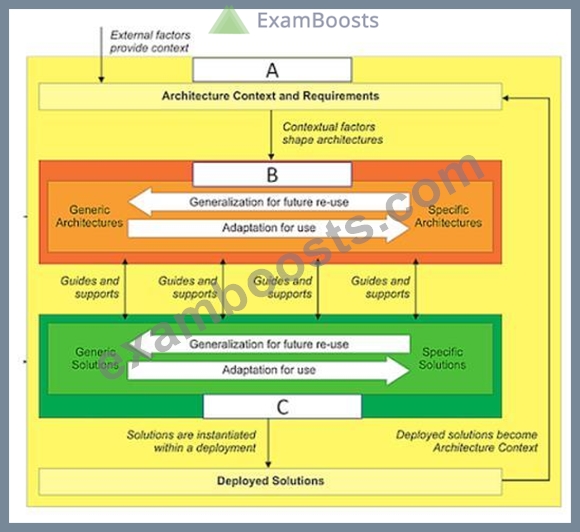
What are the items labelled A, B and C?
- A. A-Enterprise Architecture, B-Architecture Building Blocks, C-Solutions Building Blocks
- B. A-Enterprise Strategic Architecture, B-Segment Architecture, C-Solutions Architecture
- C. A-Enterprise Continuum, B-Architecture Continuum, C-Solutions Continuum
- D. A-Architecture Vision, B-Business Architecture, C-Information Systems Architecture
Answer: C
Explanation:
The illustration shows the relationship between the Enterprise Continuum, the Architecture Continuum, and the Solutions Continuum, which are key concepts in the TOGAF framework. The Enterprise Continuum is a view of the Architecture Repository that shows how generic foundation architectures can be leveraged and specialized to support the requirements of an individual organization. The Architecture Continuum specifies a structured classification for architectural artifacts, such as models, patterns, and descriptions, that can be reused and adapted across different domains and levels of abstraction. The Solutions Continuum identifies implemented solutions that support various stages of business and IT capability evolution, such as common systems, industry solutions, and organization-specific solutions. The illustration also shows how the architecture context and requirements are influenced by external factors, such as business drivers, stakeholders, and standards, and how they shape the generic and specific architectures and solutions. The illustration also shows how the deployed solutions become part of the architecture context for future iterations of the architecture development cycle. References:
*TOGAF Standard, 10th Edition, Part II: Architecture Development Method, Chapter 6: Architecture Repository, Section 6.2 Enterprise Continuum.
*TOGAF Standard, 10th Edition, Part IV: Architecture Content Framework, Chapter 35: Enterprise Continuum and Tools, Section 35.1 Introduction.
NEW QUESTION # 78
Which statement about Requirements Management is most correct?
- A. Requirements Management and stakeholder engagement are placed at the center of architecture development
- B. Requirements Management is a step of all ADM Phases
- C. The purpose of Requirements Management is to process change requests
- D. Stakeholder requirements are captured once in Phase A and managed throughout the ADM cycle
Answer: A
Explanation:
Explanation
This statement about Requirements Management is most correct because it reflects the central role of Requirements Management and stakeholder engagement in the ADM cycle. Requirements Management is not a step of all ADM Phases, but rather an ongoing process that ensures that all relevant requirements are elicited, analyzed, prioritized, and addressed throughout the architecture development and transition. Stakeholder engagement is also a continuous activity that involves identifying, communicating, and managing stakeholder expectations and concerns. Reference: The TOGAF Standard | The Open Group Website, Section 3.1 Introduction to the ADM.
NEW QUESTION # 79
Which of the following statements about architecture partitioning are correct*?
1 Partitions are used to simplify the management of the Enterprise Architecture
2 Partitions are equivalent to architecture levels
3 Partitions enable different teams to work on different element of the architecture at the same time.
4 Partitions reflect the organization's structure
- A. 1 & 3
- B. 1 & 4
- C. 2 & 3
- D. 2 & 4
Answer: A
Explanation:
Statements 1 and 3 about architecture partitioning are correct. Architecture partitioning is the technique of dividing an architecture into smaller and more manageable parts that can be developed, maintained, and governed independently. Partitions are used to simplify the management of the Enterprise Architecture and to enable different teams to work on different elements of the architecture at the same time. Partitions are not equivalent to architecture levels, which are different degrees of abstraction or detail in an architecture.
Partitions do not necessarily reflect the organization's structure, which may change over time or differ from the architecture's scope and boundaries. Reference: The TOGAF Standard | The Open Group Website, Section 2.5 Architecture Partitioning.
NEW QUESTION # 80
Consider the following ADM phases objectives.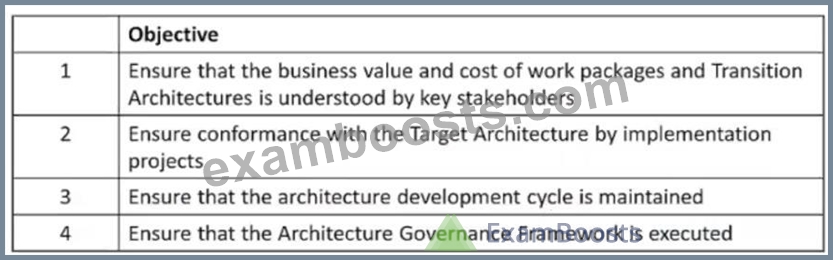
Which phase does each objective match?
- A. 1H-2F-3F-4G
- B. 1G-2H-3H-4F
- C. 1F-2G-3H-4H
- D. 1F-2G-3G-4H
Answer: D
Explanation:
Explanation
1F: To define an Implementation and Migration Strategy that will achieve an orderly transition from the Baseline to Target Architectures 2G: To perform appropriate governance functions while the solution is being implemented 3G: To ensure conformance with the Target Architecture by implementation projects 4H: To establish procedures for continual monitoring and assessment of the performance of the solution in operation Reference: The TOGAF Standard | The Open Group Website, Section 3.2 ADM Phases.
NEW QUESTION # 81
Exhibit: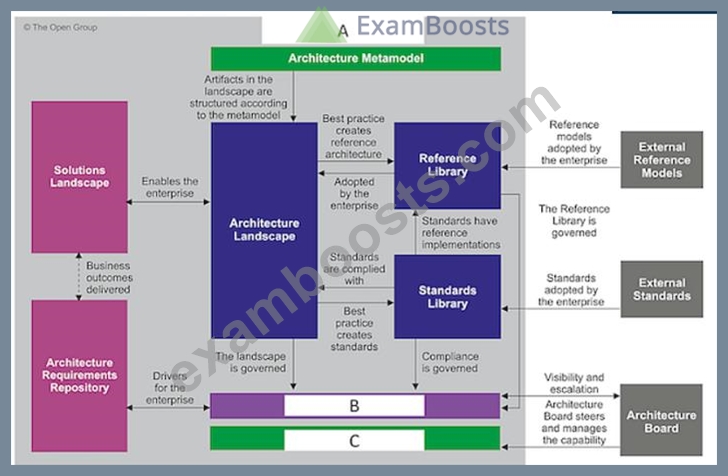
Consider the illustration. What are the items labelled A, B, and C?
- A. A-Enterprise Repository, B-Board repository, C-Enterprise Capability
- B. A-Architecture Repository, B-Governance Repository, C-Architecture Capability
- C. A-Architecture Repository, B-Governing Board, C-Enterprise Capability
- D. A-Enterprise Repository, B-Governance Repository, C-Board Repository
Answer: C
Explanation:
A-Architecture Repository: This is a part of the Architecture Metamodel that contains artifacts structured according to the metamodel. It includes the Architecture Landscape which is adopted by the enterprise and governed by certain standards and practices.
B-Governing Board: The Governing Board ensures visibility and escalation, meaning it oversees and manages the capability of the architecture landscape. It plays a crucial role in governance.
C-Enterprise Capability: This refers to how well an enterprise can execute its mission, meet business objectives or satisfy its stakeholders' needs and expectations. It's influenced by both internal factors (like resources, processes) and external ones (like market trends).
NEW QUESTION # 82
Which of the following statements about architecture partitioning are correct*?
1 Partitions are used to simplify the management of the Enterprise Architecture
2 Partitions are equivalent to architecture levels
3 Partitions enable different teams to work on different element of the architecture at the same time.
4 Partitions reflect the organization's structure
- A. 1 & 3
- B. 1 & 4
- C. 2 & 3
- D. 2 & 4
Answer: A
Explanation:
Statements 1 and 3 about architecture partitioning are correct. Architecture partitioning is the technique of dividing an architecture into smaller and more manageable parts that can be developed, maintained, and governed independently. Partitions are used to simplify the management of the Enterprise Architecture and to enable different teams to work on different elements of the architecture at the same time. Partitions are not equivalent to architecture levels, which are different degrees of abstraction or detail in an architecture. Partitions do not necessarily reflect the organization's structure, which may change over time or differ from the architecture's scope and boundaries. Reference: The TOGAF Standard | The Open Group Website, Section 2.5 Architecture Partitioning.
NEW QUESTION # 83
Consider the following ADM phases objectives.
Objective
1-Determine whether an incremental approach is required, and if so identify Transition Architectures that will deliver continuous business value
2-Generate the initial complete version of the Architecture Roadmap, based upon the gap analysis and candidate Architecture Roadmap components from Phases B, C, and D
3-Finalize the Architecture Roadmap and the supporting Implementation and Migration Plan
4-Ensure that the business value and cost of work packages and Transition Architectures is understood by key stakeholders Which phase does each objective match?
- A. 1G-2E-3F-4F
- B. 1F-2E-3F-4G
- C. 1E-2F-3E-4F
- D. 1E-2E-3F-4F
Answer: A
Explanation:
Explanation
According to the TOGAF standard, the objectives of each ADM phase are as follows1:
*Phase E: Opportunities and Solutions
oDetermine whether an incremental approach is required, and if so identify Transition Architectures that will deliver continuous business value oIdentify and group major work packages within the Architecture Roadmap oIdentify and group major implementation projects to realize the Architecture Roadmap oIdentify dependencies between increments and projects oEstimate cost, benefit, and risk at a high level for each increment and project oConduct initial prioritization and sequencing of the Architecture Roadmap and projects
*Phase F: Migration Planning
oGenerate the initial complete version of the Architecture Roadmap, based upon the gap analysis and candidate Architecture Roadmap components from Phases B, C, and D oConfirm the Transition Architectures with relevant stakeholders oCreate the Implementation and Migration Plan, including Transition Architectures, work packages, projects, and other activities oConfirm and agree the Architecture Roadmap and Implementation and Migration Plan with relevant stakeholders
*Phase G: Implementation Governance
oFinalize the Architecture Roadmap and the supporting Implementation and Migration Plan oEnsure conformance with the Target Architecture by implementation projects oPerform appropriate Architecture Governance functions for the solution and any implementation-driven architecture Change Requests oEnsure that the architecture lifecycle is maintained oEnsure that the Architecture Governance Framework is executed
*Phase H: Architecture Change Management
oEnsure that the business value and cost of work packages and Transition Architectures is understood by key stakeholders oManage risks and issues related to the Architecture Roadmap and Implementation and Migration Plan oMonitor the implementation projects and Transition Architectures oManage changes to the architecture baseline oManage changes to the Architecture Capability Therefore, the correct matching of the objectives and the phases is:
*1G: Determine whether an incremental approach is required, and if so identify Transition Architectures that will deliver continuous business value
*2E: Generate the initial complete version of the Architecture Roadmap, based upon the gap analysis and candidate Architecture Roadmap components from Phases B, C, and D
*3F: Finalize the Architecture Roadmap and the supporting Implementation and Migration Plan
*4F: Ensure that the business value and cost of work packages and Transition Architectures is understood by key stakeholders References: 1: The TOGAF Architecture Development Method
NEW QUESTION # 84
Which of the following describes a purpose of Architecture Principles?
- A. To describe likely impacts resulting from successful deployment of the target architecture.
- B. To form a contract between sponsoring organization and the enterprise architects
- C. To establish a common understanding of how to control the business in pursuit of strategic objectives
- D. To provide a better understanding about the enterprise's culture and values
Answer: C
Explanation:
Architecture Principles are general rules and guidelines that inform and support the way in which an organization sets about fulfilling its mission. They reflect a level of consensus among the various elements of the enterprise, and form the basis for making future IT decisions. One of the purposes of Architecture Principles is to establish a common understanding of how to control the business in pursuit of strategic objectives, by providing a framework for evaluating and agreeing on the changes that affect the enterprise's architecture3 Reference: 3: The TOGAF Standard, Version 9.2, Part III: ADM Guidelines and Techniques, Chapter 23: Architecture Principles : The TOGAF Standard, Version 9.2, Part IV: Architecture Content Framework, Chapter 31: Architecture Principles
NEW QUESTION # 85
Which of the following supports the need to govern Enterprise Architecture?
- A. The Architecture Project mandates the governance of the target architecture
- B. The TOGAF standard cannot be used without executive governance
- C. Best practice governance enables the organization to control value realization
- D. The Stakeholders preferences may go beyond the architecture project scope and needs control
Answer: C
Explanation:
This statement best supports the need to govern Enterprise Architecture. Best practice governance enables the organization to control value realization by ensuring that architectures are aligned with the enterprise's strategy and objectives, meet the quality and performance requirements, and deliver the expected benefits and outcomes. The Architecture Project does not mandate the governance of the target architecture, but rather follows the governance framework established by the enterprise. The TOGAF standard can be used without executive governance, but it is recommended that executive sponsorship and support are obtained for successful architecture development and transition. The Stakeholders preferences may go beyond the architecture project scope and need control, but this is not the primary reason for governing Enterprise Architecture. Reference: The TOGAF Standard | The Open Group Website, Section 3.3.6 Architecture Governance.
NEW QUESTION # 86
Scenario
Your role is that of an Enterprise Architect, reporting to the Chief Enterprise Architect, at a technology company.
The company uses the TOGAF standard as the method and guiding framework for its Enterprise Architecture (EA) practice. The Chief Technology Officer (CTO) is the sponsor of the activity. The EA practice uses an iterative approach for its architecture development. This has enabled the decision- makers to gain valuable insights into the different aspects of the business.
The nature of the business is such that the data and the information stored on the company systems is the company's major asset and is highly confidential. The company employees travel a lot for work and need to communicate over public infrastructure. They use message encryption, secure internet connections using Virtual Private Networks (VPNs), and other standard security measures. The company has provided computer security awareness training for all its staff. However, despite good education and system security, there is still a need to rely on third-party suppliers for infrastructure and software.
The Chief Security Officer (CSO) has noted an increase in ransomware (malicious software used in ransom demands) attacks on companies with a similar profile. The CSO recognizes that no matter how much is spent on education and support, the company could be a victim of a significant attack that could completely lock them out of their important data.
A risk assessment has been completed, and the company has looked for cyber insurance that covers ransomware. The price for this insurance is very high. The CTO recently saw a survey that said 1 out of 4 businesses that paid ransoms could not get their data back, and almost the same number were able to recover the data without paying. The CTO has decided not to get cyber insurance to cover ransom payment.
You have been asked to describe the steps you would take to strengthen the current architecture to improve data protection.
Based on the TOGAF standard, which of the following is the best answer?
- A. You would monitor for technology updates from your existing suppliers that could enhance the company's capabilities to detect, react, and recover from an IT security incident. You would prepare and run a disaster recovery planning exercise for a ransomware attack and analyze the performance of the current Enterprise Architecture. Using the findings, you would prepare a gap analysis of the current Enterprise Architecture. You would prepare change requests to address identified gaps. You would add the changes implemented to the Architecture Repository.
- B. You would request an Architecture Compliance Review with the scope to examine the company's ability to respond to ransomware attacks. You would identify the departments involved and have them nominate representatives. You would then tailor checklists to address the requirement for increased resilience. You would circulate to the nominated representatives for them to complete. You would then review the completed checklists, identifying and resolving issues. You would then determine and present your recommendations.
- C. You would ensure that the company has in place up-to-date processes for managing change to the current Enterprise Architecture. Based on the scope of the concerns raised, you recommend that this be managed at the infrastructure level. Changes should be made to the baseline description of the Technology Architecture. The changes should be approved by the Architecture Board and implemented by change management techniques.
- D. You would assess business continuity requirements and analyze the current Enterprise Architecture for gaps. You would recommend changes to address the situation and create a change request. You would engage the Architecture Board to assess and approve the change request. Once approved, you would create a new Request for Architecture Work to begin an ADM cycle to implement the changes.
Answer: B
Explanation:
Comprehensive and Detailed Step-by-Step Explanation
Context of the Scenario
The scenario highlights significant risks due to ransomware attacks and the need to strengthen the company's Enterprise Architecture to improve data protection and resilience. TOGAF emphasizes the Architecture Compliance Review as a mechanism for ensuring the architecture meets its objectives and addresses specific concerns such as security, resilience, and compliance with organizational goals.
The organization has already conducted a risk assessment but requires actionable steps to:
* Address ransomware attack risks.
* Increase the resilience of the Technology Architecture.
* Ensure proper alignment with governance and compliance frameworks.
Option Analysis
Option A:
* Strengths:
* Highlights the need for up-to-date processes for managing changes in the Enterprise Architecture.
* Recognizes the importance of governance through the Architecture Board and change management techniques.
* Weaknesses:
* The approach focuses solely on the Technology Architecture baseline but does not address the need for specific steps such as compliance review, gap analysis, or tailored resilience measures for ransomware risks.
* It provides a broad and generic approach rather than a targeted plan for ransomware and data protection issues.
* Conclusion: Incorrect. While it adheres to governance processes, it lacks specific actions to improve resilience and address the immediate security concerns.
Option B:
* Strengths:
* Proposes an Architecture Compliance Review, which is a core TOGAF process used to evaluate architecture implementation against defined objectives, ensuring it is fit for purpose.
* Involves identifying stakeholders (departments) and tailoring checklists specific to ransomware resilience.
* Emphasizes issue identification and resolution through structured review processes.
* Weaknesses:
* Does not explicitly address longer-term updates to the Enterprise Architecture, but this can be inferred as a next step following compliance recommendations.
* Conclusion: Correct. This is the most suitable approach based on TOGAF principles, as it uses an established process to evaluate and improve the architecture's resilience.
Option C:
* Strengths:
* Includes monitoring for updates from suppliers to enhance detection and recovery capabilities, which is relevant to addressing ransomware risks.
* Proposes a gap analysis to identify shortcomings in the current Enterprise Architecture and recommends addressing gaps through change requests.
* Incorporates disaster recovery planning exercises, which are useful for testing resilience.
* Weaknesses:
* While thorough, the approach lacks the Architecture Compliance Review process, which is a more structured way to ensure the architecture meets resilience requirements.
* Monitoring suppliers and running disaster recovery exercises are operational steps rather than strategic architectural improvements.
* Conclusion: Incorrect. While it includes valid activities, it does not adhere to TOGAF's structured approach for architecture assessment and compliance.
Option D:
* Strengths:
* Proposes analyzing business continuity requirements and assessing the architecture for gaps, which is relevant to the scenario.
* Suggests initiating an ADM cycle to address gaps, which aligns with TOGAF principles.
* Weaknesses:
* Focusing on initiating a new ADM cycle may be premature, as the immediate priority is to evaluate the existing architecture and address specific resilience concerns.
* Does not mention compliance review or tailored resilience measures for ransomware attacks, which are central to the scenario.
* Conclusion: Incorrect. It proposes a broader approach that may not adequately address the immediate concerns highlighted by the CSO.
TOGAF References
* Architecture Compliance Review: A structured process used to evaluate whether an architecture meets the stated goals, objectives, and requirements (TOGAF 9.2, Chapter 19). It is particularly useful for identifying and addressing resilience requirements in scenarios involving security risks.
* Stakeholder Engagement: Identifying and involving stakeholders (e.g., departments) is a critical part of architecture governance and compliance review (TOGAF 9.2, Section 24.2).
* Change Management: The Architecture Compliance Review supports identifying necessary changes, which are then managed through governance and change management processes (TOGAF 9.2, Section
21.6).
By choosing Option B, you align with TOGAF's structured approach to compliance, resilience, and addressing security concerns.
NEW QUESTION # 87
Exhibit: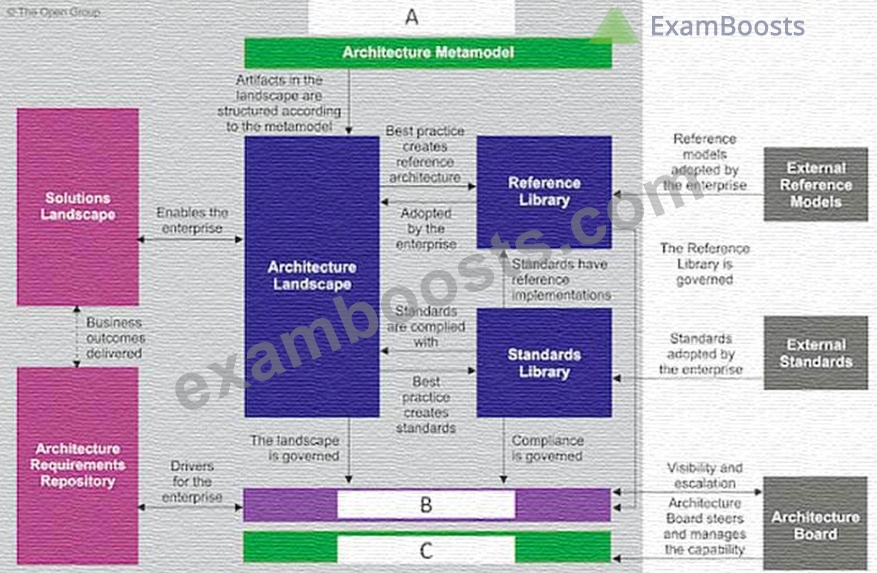
Consider the illustration. What are the items labelled A, B, and C?
- A. A-Enterprise Repository, B-Board repository, C-Enterprise Capability
- B. A-Architecture Repository, B-Governance Repository, C-Architecture Capability
- C. A-Architecture Repository, B-Governing Board, C-Enterprise Capability
- D. A-Enterprise Repository, B-Governance Repository, C-Board Repository
Answer: C
Explanation:
A-Architecture Repository: This is a part of the Architecture Metamodel that contains artifacts structured according to the metamodel. It includes the Architecture Landscape which is adopted by the enterprise and governed by certain standards and practices.
B-Governing Board: The Governing Board ensures visibility and escalation, meaning it oversees and manages the capability of the architecture landscape. It plays a crucial role in governance.
C-Enterprise Capability: This refers to how well an enterprise can execute its mission, meet business objectives or satisfy its stakeholders' needs and expectations. It's influenced by both internal factors (like resources, processes) and external ones (like market trends).
References: TOGAF Version 9.1, Chapter 34: 1
NEW QUESTION # 88
Scenario
Your role is that of an Enterprise Architect, reporting to the Chief Enterprise Architect, at a technology company.
The company uses the TOGAF standard as the method and guiding framework for its Enterprise Architecture (EA) practice. The Chief Technology Officer (CTO) is the sponsor of the activity. The EA practice uses an iterative approach for its architecture development. This has enabled the decision-makers to gain valuable insights into the different aspects of the business.
The nature of the business is such that the data and the information stored on the company systems is the company's major asset and is highly confidential. The company employees travel a lot for work and need to communicate over public infrastructure. They use message encryption, secure internet connections using Virtual Private Networks (VPNs), and other standard security measures. The company has provided computer security awareness training for all its staff. However, despite good education and system security, there is still a need to rely on third-party suppliers for infrastructure and software.
The Chief Security Officer (CSO) has noted an increase in ransomware (malicious software used in ransom demands) attacks on companies with a similar profile. The CSO recognizes that no matter how much is spent on education and support, the company could be a victim of a significant attack that could completely lock them out of their important data.
A risk assessment has been completed, and the company has looked for cyber insurance that covers ransomware. The price for this insurance is very high. The CTO recently saw a survey that said 1 out of 4 businesses that paid ransoms could not get their data back, and almost the same number were able to recover the data without paying. The CTO has decided not to get cyber insurance to cover ransom payment.
You have been asked to describe the steps you would take to strengthen the current architecture to improve data protection.
Based on the TOGAF standard, which of the following is the best answer?
- A. You would monitor for technology updates from your existing suppliers that could enhance the company's capabilities to detect, react, and recover from an IT security incident. You would prepare and run a disaster recovery planning exercise for a ransomware attack and analyze the performance of the current Enterprise Architecture. Using the findings, you would prepare a gap analysis of the current Enterprise Architecture. You would prepare change requests to address identified gaps. You would add the changes implemented to the Architecture Repository.
- B. You would request an Architecture Compliance Review with the scope to examine the company's ability to respond to ransomware attacks. You would identify the departments involved and have them nominate representatives. You would then tailor checklists to address the requirement for increased resilience. You would circulate to the nominated representatives for them to complete. You would then review the completed checklists, identifying and resolving issues. You would then determine and present your recommendations.
- C. You would ensure that the company has in place up-to-date processes for managing change to the current Enterprise Architecture. Based on the scope of the concerns raised, you recommend that this be managed at the infrastructure level. Changes should be made to the baseline description of the Technology Architecture. The changes should be approved by the Architecture Board and implemented by change management techniques.
- D. You would assess business continuity requirements and analyze the current Enterprise Architecture for gaps. You would recommend changes to address the situation and create a change request. You would engage the Architecture Board to assess and approve the change request. Once approved, you would create a new Request for Architecture Work to begin an ADM cycle to implement the changes.
Answer: B
Explanation:
Comprehensive and Detailed Step-by-Step Explanation
Context of the Scenario
The scenario highlights significant risks due to ransomware attacks and the need to strengthen the company's Enterprise Architecture to improve data protection and resilience. TOGAF emphasizes the Architecture Compliance Review as a mechanism for ensuring the architecture meets its objectives and addresses specific concerns such as security, resilience, and compliance with organizational goals.
The organization has already conducted a risk assessment but requires actionable steps to:
Address ransomware attack risks.
Increase the resilience of the Technology Architecture.
Ensure proper alignment with governance and compliance frameworks.
Option Analysis
Option A:
Strengths:
Highlights the need for up-to-date processes for managing changes in the Enterprise Architecture.
Recognizes the importance of governance through the Architecture Board and change management techniques.
Weaknesses:
The approach focuses solely on the Technology Architecture baseline but does not address the need for specific steps such as compliance review, gap analysis, or tailored resilience measures for ransomware risks.
It provides a broad and generic approach rather than a targeted plan for ransomware and data protection issues.
Conclusion: Incorrect. While it adheres to governance processes, it lacks specific actions to improve resilience and address the immediate security concerns.
Option B:
Strengths:
Proposes an Architecture Compliance Review, which is a core TOGAF process used to evaluate architecture implementation against defined objectives, ensuring it is fit for purpose.
Involves identifying stakeholders (departments) and tailoring checklists specific to ransomware resilience.
Emphasizes issue identification and resolution through structured review processes.
Weaknesses:
Does not explicitly address longer-term updates to the Enterprise Architecture, but this can be inferred as a next step following compliance recommendations.
Conclusion: Correct. This is the most suitable approach based on TOGAF principles, as it uses an established process to evaluate and improve the architecture's resilience.
Option C:
Strengths:
Includes monitoring for updates from suppliers to enhance detection and recovery capabilities, which is relevant to addressing ransomware risks.
Proposes a gap analysis to identify shortcomings in the current Enterprise Architecture and recommends addressing gaps through change requests.
Incorporates disaster recovery planning exercises, which are useful for testing resilience.
Weaknesses:
While thorough, the approach lacks the Architecture Compliance Review process, which is a more structured way to ensure the architecture meets resilience requirements.
Monitoring suppliers and running disaster recovery exercises are operational steps rather than strategic architectural improvements.
Conclusion: Incorrect. While it includes valid activities, it does not adhere to TOGAF's structured approach for architecture assessment and compliance.
Option D:
Strengths:
Proposes analyzing business continuity requirements and assessing the architecture for gaps, which is relevant to the scenario.
Suggests initiating an ADM cycle to address gaps, which aligns with TOGAF principles.
Weaknesses:
Focusing on initiating a new ADM cycle may be premature, as the immediate priority is to evaluate the existing architecture and address specific resilience concerns.
Does not mention compliance review or tailored resilience measures for ransomware attacks, which are central to the scenario.
Conclusion: Incorrect. It proposes a broader approach that may not adequately address the immediate concerns highlighted by the CSO.
TOGAF Reference
Architecture Compliance Review: A structured process used to evaluate whether an architecture meets the stated goals, objectives, and requirements (TOGAF 9.2, Chapter 19). It is particularly useful for identifying and addressing resilience requirements in scenarios involving security risks.
Stakeholder Engagement: Identifying and involving stakeholders (e.g., departments) is a critical part of architecture governance and compliance review (TOGAF 9.2, Section 24.2).
Change Management: The Architecture Compliance Review supports identifying necessary changes, which are then managed through governance and change management processes (TOGAF 9.2, Section 21.6).
By choosing Option B, you align with TOGAF's structured approach to compliance, resilience, and addressing security concerns.
NEW QUESTION # 89
Which of the following best describes the purpose of the Architecture Requirements Specification?
- A. It contains an assessment of the current architecture requirements
- B. It provides a set of statements that outline what a project must do to comply with the architecture
- C. It is sent from the sponsor and triggers the start of an architecture development cycle
- D. It defines the scope and approach to complete an architecture project
Answer: B
Explanation:
The Architecture Requirements Specification is one of the TOGAF deliverables that provides a set of quantitative statements that outline what an implementation project must do in order to comply with the architecture12. It is a companion to the Architecture Definition Document, which provides a qualitative view of the solution and aims to communicate the intent of the architect. The Architecture Requirements Specification provides a quantitative view of the solution, stating measurable criteria that must be met during the implementation of the architecture3. It typically forms a major component of an implementation contract or contract for more detailed Architecture Definition4. Reference:
* Deliverable: Architecture Requirements Specification - The Open Group
* Architecture Requirements Specification - Visual Paradigm Community Circle
* The TOGAF Standard, Version 9.2 - Definitions - The Open Group
* The TOGAF Standard, Version 9.2 - Architecture Requirements Specification - The Open Group
NEW QUESTION # 90
Consider the illustration.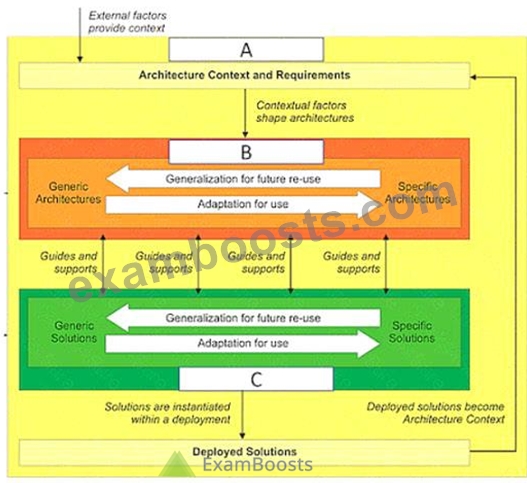
What are the items labelled A, B and C?
- A. A-Enterprise Architecture, B-Architecture Building Blocks, C-Solutions Building Blocks
- B. A-Enterprise Strategic Architecture, B-Segment Architecture, C-Solutions Architecture
- C. A-Enterprise Continuum, B-Architecture Continuum, C-Solutions Continuum
- D. A-Architecture Vision, B-Business Architecture, C-Information Systems Architecture
Answer: C
Explanation:
The illustration shows the relationship between the Enterprise Continuum, the Architecture Continuum, and the Solutions Continuum, which are key concepts in the TOGAF framework. The Enterprise Continuum is a view of the Architecture Repository that shows how generic foundation architectures can be leveraged and specialized to support the requirements of an individual organization. The Architecture Continuum specifies a structured classification for architectural artifacts, such as models, patterns, and descriptions, that can be reused and adapted across different domains and levels of abstraction. The Solutions Continuum identifies implemented solutions that support various stages of business and IT capability evolution, such as common systems, industry solutions, and organization-specific solutions. The illustration also shows how the architecture context and requirements are influenced by external factors, such as business drivers, stakeholders, and standards, and how they shape the generic and specific architectures and solutions. The illustration also shows how the deployed solutions become part of the architecture context for future iterations of the architecture development cycle. References:
*TOGAF Standard, 10th Edition, Part II: Architecture Development Method, Chapter 6: Architecture Repository, Section 6.2 Enterprise Continuum.
*TOGAF Standard, 10th Edition, Part IV: Architecture Content Framework, Chapter 35: Enterprise Continuum and Tools, Section 35.1 Introduction.
NEW QUESTION # 91
......
Truly Beneficial For Your The Open Group Exam: https://www.examboosts.com/TheOpenGroup/OGEA-103-practice-exam-dumps.html
Download The Open Group OGEA-103 Sample Questions: https://drive.google.com/open?id=1fMZqSfj0TVXrY84OPq751G720ySjlqew