

JN0-481 Dumps are Available for Instant Access [2025]
Practice with these JN0-481 dumps Certification Sample Questions
NEW QUESTION # 31
You have recently committed a change after creating a new blueprint in Juniper Apstra. In the main dashboard, you see a number of anomalies related to BGR What is a likely cause of these anomalies?
- A. Spine-leaf links are incorrectly set.
- B. A generic system has not been configured.
- C. You have misconfigured ASNs.
- D. The fabric has not converged yet.
Answer: D
Explanation:
In Juniper Apstra, a blueprint is a logical representation of the network design and configuration.
When you create a new blueprint, you need to commit the changes to apply them to the network devices. However, committing the changes does not mean that the network is immediately updated and operational. It may take some time for the network to converge and reflect the new state of the blueprint. During this time, you may see some anomalies related to BGP in the main dashboard, which indicate that the BGP sessions are not established or stable between the devices. These anomalies are usually temporary and will disappear once the network converges and the BGP sessions are up and running.
NEW QUESTION # 32
Which two statements about VXLAN VNIs are correct? (Choose two.)
- A. VNIs identify a broadcast domain
- B. VNIs can have over 16 million unique values.
- C. VNIs are alphanumeric values.
- D. VNIs identify a collision domain.
Answer: A,B
Explanation:
VXLAN VNIs are virtual network identifiers that are used to identify and isolate Layer 2 segments in the overlay network. VXLAN VNIs have the following characteristics:
VNIs can have over 16 million unique values. This is because VXLAN VNIs are 24-bit fields that can range from 4096 to 16777214, according to the VXLAN standard. This allows VXLAN to support a large number of Layer 2 segments and tenants in the network. VNIs identify a broadcast domain. This is because VXLAN VNIs are used to group the end hosts that belong to the same Layer 2 segment and can communicate with each other using VXLAN tunnels. The VXLAN tunnels are established using the VTEP information that is distributed by EVPN. The VTEPs are VXLAN tunnel endpoints that perform the VXLAN encapsulation and decapsulation.
The VXLAN tunnels preserve the Layer 2 semantics and support the broadcast, unknown unicast, and multicast traffic within the same VNI.
NEW QUESTION # 33
A member of your organization made changes to a predefined interface map using Juniper Apstra. Which two statements are correct in this scenario? (Choose two.)
- A. Changes made to predefined interface maps will not have an impact on the Apstra software.
- B. Changes to interface maps in the global catalog will raise anomalies that may need to be addressed at the next commit.
- C. Changes to interface maps in the global catalog do not affect interface maps that have already been imported into blueprint catalogs
- D. Any changes made to predefined interface maps are discarded when Apstra is upgraded.
Answer: C,D
Explanation:
An interface map is a configuration template that maps interfaces between logical devices and physical hardware devices (represented with device profiles) while adhering to vendor specifications. An interface map can be either predefined or custom. A predefined interface map is one that ships with Apstra software and supports most qualified Juniper devices. A custom interface map is one that is created by the user to meet specific requirements. An interface map can be stored in either the global catalog or the blueprint catalog. The global catalog contains all the interface maps that are available for use in any blueprint. The blueprint catalog contains the interface maps that are imported from the global catalog and used in a specific blueprint.
NEW QUESTION # 34
Which fabric type should be chosen in a template to create a five-stage Clos?
- A. rack-based
- B. pod-based
- C. collapsed
- D. circuit switched
Answer: B
Explanation:
A five-stage Clos architecture allows for large-scale topologies with an additional aggregation layer that interconnects multiple pods into a single fabric. A pod is a group of racks that share the same spine devices. A rack is a group of leaf devices that connect to the same servers. To create a five-stage Clos network using Juniper Apstra, you need to choose the pod-based fabric type in the template creation wizard. This will allow you to specify the number of pods, planes, spines, and leaves for your network design.
NEW QUESTION # 35
In the Juniper Apstra design phase, which object dictates port count, port speed, and how the ports would be used?
- A. rack type
- B. network devices
- C. logical devices
- D. interface map
Answer: D
Explanation:
Interface maps are objects that map interfaces between logical devices and physical hardware devices in the Juniper Apstra design phase. They dictate port count, port speed, and how the ports would be used for achieving the intended network configuration rendering. Interface maps also allow you to select device ports, transformations, and interfaces, provision breakout ports, and disable unused ports.
NEW QUESTION # 36
What is the purpose of a Juniper Apstra rack?
- A. It stores information on how pods connect to super spines.
- B. It stores information on how leaf nodes connect to generic devices
- C. It stores IP address and ASN pool information.
- D. It stores device port data rates and vendor information.
Answer: B
Explanation:
A Juniper Apstra rack is a physical entity that contains one or more network devices, such as leaf nodes, access switches, or generic systems. A rack is used to organize and manage the network devices in the Apstra software application. A rack has the following characteristics:
It stores information on how leaf nodes connect to generic devices. This is because a rack can include generic systems, which are devices that are not managed by Juniper Apstra, but are connected to the network. A generic system can be a server, a firewall, a load balancer, or any other device that has a network interface. A rack stores the information on how the leaf nodes, which are the devices that provide access to the end hosts, connect to the generic devices, such as the port number, the link speed, the LAG mode, and the roles.
It has a rack type, which defines the type and number of leaf devices, access switches, and/or generic systems that are used in the rack. A rack type is a resource that is created in the data center design phase, and it does not specify the vendor or the model of the devices. A rack type can be predefined or custom-made, and it can be used to create multiple racks with the same structure and configuration.
It has a rack build, which assigns the specific vendor and model of the devices to the rack. A rack build is created in the staged phase, and it uses the rack type as a template. A rack build can also assign the resources, such as the IP addresses, the ASNs, and the VNIs, to the devices in the rack. It has a rack deployment, which applies the network configuration and services to the devices in the rack. A rack deployment is performed in the active phase, and it uses the rack build as a reference. A rack deployment can also monitor the network performance and compliance of the devices in the rack.
NEW QUESTION # 37
Referring to the exhibit, which role does Device A serve in an IP fabric?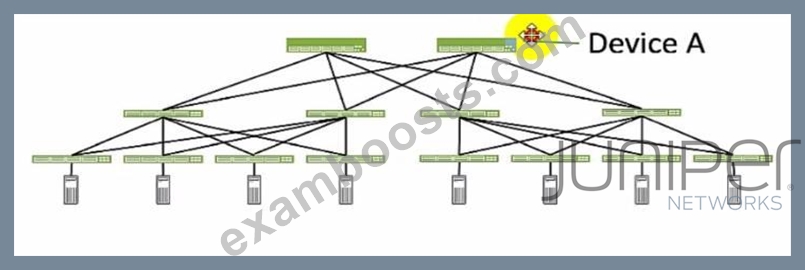
- A. spine
- B. server
- C. super spine
- D. leaf
Answer: A
Explanation:
Device A serves as a spine in an IP fabric. An IP fabric is a network architecture that uses a spine-leaf topology to provide high performance, scalability, and reliability for data center networks. A spine- leaf topology consists of two layers of devices: spine devices and leaf devices.
Spine devices are the core devices that interconnect all the leaf devices using equal-cost multipath (ECMP) routing. Leaf devices are the edge devices that connect to the servers, storage, or other network devices. In the exhibit, Device A is connected to four leaf devices using multiple links, which indicates that it is a spine device.
NEW QUESTION # 38
Referring to the exhibit, how many broadcast domains will an Ethernet frame pass through when traversing the IP fabric from Server A to Server B?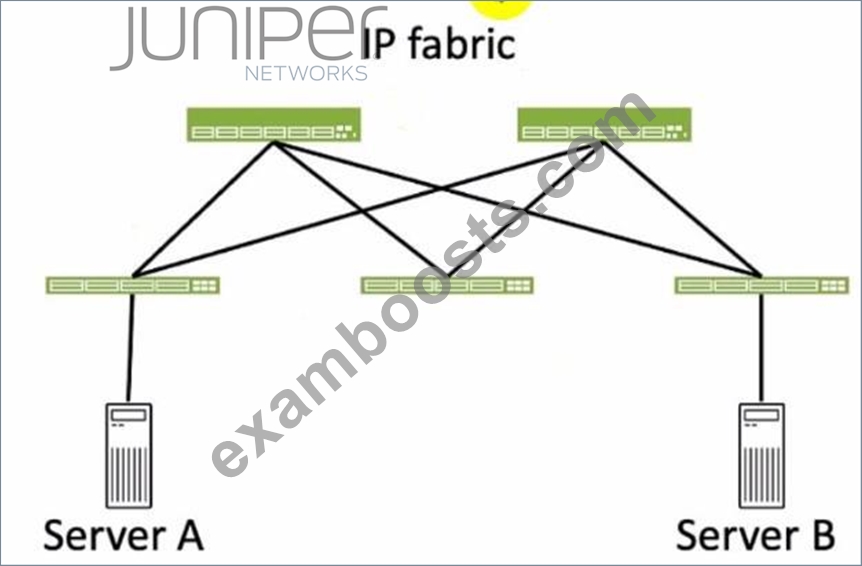
- A. 0
- B. 1
- C. 2
- D. 3
Answer: D
Explanation:
Referring to the exhibit, the image shows a simplified diagram of an IP fabric network connecting two servers, labeled as Server A and Server B. The IP fabric is a network architecture that uses a Clos topology to provide high bandwidth, low latency, and scalability for data center networks.
The IP fabric consists of spine and leaf devices that use BGP as the routing protocol and VXLAN as the overlay technology.
A broadcast domain is a logical portion of a network where any device can directly transmit broadcast frames to other devices at the data link layer (OSI Layer 2). A broadcast frame is a frame that has a destination MAC address of all ones (FF:FF:FF:FF:FF:FF), which means that it is intended for all devices in the same broadcast domain. A broadcast domain is usually bounded by a router, which does not forward broadcast frames to other networks.
In the exhibit, there are two broadcast domains that an Ethernet frame will pass through when traversing the IP fabric from Server A to Server B. The first broadcast domain is the one that contains Server A and the leaf device that it is connected to. The second broadcast domain is the one that contains Server B and the leaf device that it is connected to. The IP fabric itself is not a broadcast domain, because it uses IP routing and VXLAN encapsulation to transport the Ethernet frames over the Layer 3 network.
NEW QUESTION # 39
Which two protocols can be used to advertise EVPN routes? (Choose two.)
- A. IS-IS
- B. MP-IBGP
- C. OSPF
- D. MP-EBGP
Answer: B,D
NEW QUESTION # 40
When working with logical devices, you specify where each port group is connected. In this scenario, which two Juniper Apstra Ul options are available to the operator? {Choose two.)
- A. generic
- B. unused
- C. firewall
- D. router
Answer: A,B
Explanation:
When working with logical devices, you specify where each port group is connected by selecting the port group layout and the port speed and role (s) for each port group. The Juniper Apstra UI offers two options to the operator for the port group role: unused and generic.
Unused: This option means that the port group is not configured or used by Apstra. This can be useful for ports that are faulty, reserved, or not part of the data center fabric.
Generic: This option means that the port group is configured with a generic role that is not specific to any device type or function. This can be useful for ports that are used for testing, troubleshooting, or custom purposes.
NEW QUESTION # 41
Using the Juniper Apstra multitenancy capabilities, which approach will allow a tenant to interconnect two different routing zones?
- A. Interconnection is the default behavior.
- B. Use interconnection through an external gateway.
- C. Interconnection cannot be enabled.
- D. Use interconnection through the fabric spine nodes.
Answer: B
Explanation:
A routing zone is an L3 domain, the unit of tenancy in multi-tenant networks. You create routing zones for tenants to isolate their IP traffic from one another, thus enabling tenants to re-use IP subnets. In addition to being in its own VRF, each routing zone can be assigned its own DHCP relay server and external system connections. You can create one or more virtual networks within a routing zone, which means a tenant can stretch its L2 applications across multiple racks within its routing zone. For virtual networks with Layer 3 SVI, the SVI is associated with a Virtual Routing and Forwarding (VRF) instance for each routing zone isolating the virtual network SVI from other virtual network SVIs in other routing zones. If you're using multiple routing zones, external system connections must be from leaf switches in the fabric. Routing between routing zones must be accomplished with external systems.
NEW QUESTION # 42
In the Juniper Apstra Ul, which three resources are assigned under the Resources menu?
(Choose three.)
- A. ASN pools
- B. logical device pools
- C. VTEP pools
- D. IP address pools
- E. VNI pools
Answer: A,D,E
Explanation:
In the Juniper Apstra UI, the Resources menu allows you to create and manage global and local resources that are used for various elements of the network design and configuration. The Resources menu includes the following three types of resources that can be assigned to the network devices and virtual networks:
ASN pools: These are pools of autonomous system numbers (ASNs) that are used for the underlay routing protocol (EBGP) between the leaf and spine devices. You can create ASN pools with either 2-byte or 4-byte ASNs, and assign them to the logical devices in the blueprint. VNI pools: These are pools of virtual network identifiers (VNIs) that are used for the overlay network (VXLAN) between the end hosts. You can create VNI pools with a range of VNIs, and assign them to the virtual networks in the blueprint.
IP address pools: These are pools of IPv4 or IPv6 addresses that are used for various purposes in the network, such as the loopback addresses for the devices, the IP prefixes for the virtual networks, the host IP addresses for the end hosts, and the gateway IP addresses for the IRB interfaces. You can create IP address pools with a range of IP addresses, and assign them to the logical devices and virtual networks in the blueprint.
The following two types of resources are not assigned under the Resources menu:
VTEP pools: These are not resources that can be created or assigned by the user. VTEPs are VXLAN tunnel endpoints that are automatically generated by the Apstra server based on the loopback IP addresses of the devices. VTEPs are used as the source and destination IP addresses for the VXLAN tunnels in the overlay network.
Logical device pools: These are not resources that can be created or assigned by the user.
Logical device pools are groups of logical devices that share the same role, interface map, and resource assignments in the blueprint. Logical device pools are used to simplify the network design and configuration by applying the same settings to multiple devices.
NEW QUESTION # 43
Which statement is correct about the Juniper Apstra Rendered configuration?
- A. It is dynamically tendered at commit time.
- B. It is built at commit time and stored in a MySQL database.
- C. It is rendered from the graph database and stored locally.
- D. It is stored in a NoSQL database and incrementally updated.
Answer: A
Explanation:
The Juniper Apstra Rendered configuration is the configuration that is generated from the staged blueprint and applied to the devices in the network. The Rendered configuration is dynamically rendered at commit time, which means that it is created on the fly based on the latest changes and validations in the blueprint. The Rendered configuration is not stored in any database, but it can be viewed in the Apstra UI or downloaded as a file. The Rendered configuration reflects the desired state of the network as defined by the intent of the blueprint.
NEW QUESTION # 44
IBA probes analyze telemetry data from specified devices within a blueprint. Which component Identities devices that supply data tor a specific probe?
- A. graph query
- B. data selector
- C. processor
- D. search engine
Answer: A
Explanation:
A graph query is a component that identifies devices that supply data for a specific probe. A graph query is an expression that matches nodes in the Apstra graph database based on their attributes, such as device name, role, type, or tag. A graph query can be used to select the source devices for the input processors of a probe, as well as to filter the data by device attributes in the subsequent processors of a probe.
NEW QUESTION # 45
You connect two single-homed servers using Juniper Apstra as shown in the exhibit. You are using the ERB design blueprint with two virtual networks in a common routing zone. In this scenario, which two types of VXLAN tunnels will be automatically created by the EVPN control plane? (Choose two.)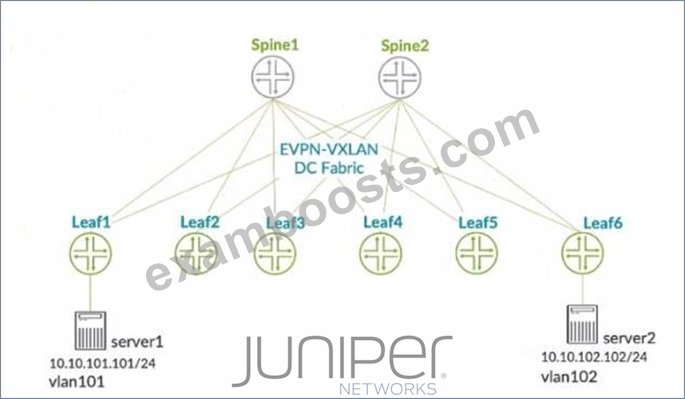
- A. EVPN signaled route Type-8 VXLAN tunnels
- B. EVPN signaled route Type-3 VXLAN tunnels
- C. EVPN signaled route Type-2 VXLAN tunnels
- D. EVPN signaled route Type-6 VXLAN tunnels
Answer: B,C
Explanation:
EVPN route Type-3 is used to advertise the IP address of the VTEP and the VNIs that it supports.
This allows the VTEPs to discover each other and form VXLAN tunnels for the VNIs that they have in common. EVPN route Type-2 is used to advertise the MAC and IP addresses of the hosts connected to the VTEPs. This allows the VTEPs to learn the MAC-to-IP bindings and the MAC-to- VTEP mappings for the hosts in the same VNI. Therefore, these two types of VXLAN tunnels will be automatically created by the EVPN control plane when using Juniper Apstra with the ERB design blueprint and two virtual networks in a common routing zone.
NEW QUESTION # 46
How does Intent-Based Analytics align with the principles of intent-based networking in terms of data exploration and analysis?
- A. By predicting future changes in the network environment
- B. By facilitating dynamic queries for intent-based data exploration
- C. By providing real-time weather updates for the data center location
- D. By managing employee property allocations in the data center
Answer: B
NEW QUESTION # 47
What does EVPN use lo identity which remote leaf device advertised the EVPN route?
- A. a route distinguisher value
- B. a VRF target value
- C. a route target value
- D. a community tag
Answer: A
Explanation:
EVPN uses a route distinguisher (RD) value to identify which remote leaf device advertised the EVPN route. An RD is a 64-bit value that is prepended to the EVPN NLRI to create a unique VPNv4 or VPNv6 prefix. The RD value is usually derived from the IP address of the PE that originates the EVPN route. By comparing the RD values of different EVPN routes, a PE can determine which remote PE advertised the route and which VRF the route belongs to.
NEW QUESTION # 48
What are two system-defined user roles that are available in Juniper Apstra? (Choose two.)
- A. user
- B. root
- C. authorized
- D. viewer
Answer: A,D
Explanation:
Juniper Apstra provides four system-defined user roles that are available in the Apstra GUI environment. They are: administrator, device_ztp, viewer, and user. Based on the web search results, we can infer the following statements:
viewer: This role includes permissions to only view various elements in the Apstra system, such as blueprints, devices, design, resources, external systems, platform, and others. Users with this role cannot create, edit, or delete any element.
user: This role includes permissions to view and edit various elements in the Apstra system, such as blueprints, devices, design, resources, external systems, platform, and others. Users with this role cannot create or delete any element.
authorized: This is not a system-defined user role in Juniper Apstra. It is a term used to describe users who have been authenticated by an external system, such as LDAP, Active Directory, TACACS+, or RADIUS.
root: This is not a system-defined user role in Juniper Apstra. It is a term used to describe the superuser account on a Linux system, which has full access to all commands and files. Creating a user in the Apstra GUI does not provide that user access to the Apstra platform via SSH. To access the Apstra platform via SSH, you must create a local Linux system user.
NEW QUESTION # 49
In Juniper Apstra. which three modes are available for devices? (Choose three.)
- A. Ready
- B. Deploy
- C. Active
- D. Stopped
- E. Drain
Answer: A,B,E
Explanation:
Juniper Apstra supports three deploy modes for devices: Deploy, Drain, and Ready. These modes determine the configuration and state of the devices in the data center fabric.
Deploy: This mode applies the full Apstra-rendered configuration to the device, according to the Apstra Reference Design. The device state becomes IS-ACTIVE and the device is ready to carry traffic in the fabric.
Drain: This mode adds a "drain" configuration to the device, which prevents any new traffic from entering the device. The device state becomes IS-READY and the device is prepared for maintenance or decommissioning.
Ready: This mode removes the Apstra-rendered configuration from the device, leaving only the basic configuration such as device hostname, interface descriptions, and port speed/breakout.
The device state becomes IS-READY and the device is not part of the fabric.
NEW QUESTION # 50
Which statement is true when onboarding a Juniper Networks device using a Juniper Apstra ZTP server?
- A. The State can be set In the ztp.Json file on the ZTP server.
- B. The Management IP address cannot be predetermined.
- C. The Device Key lo be used can be set In the dhcpd.conf file on the ZTP server.
- D. The Hostname will be the serial-number of the device.
Answer: A
Explanation:
The ztp.Json file on the Apstra ZTP server contains the configuration parameters for each device that is onboarded using ZTP. One of the parameters is the State, which can be one of the following values: init, ready, in_progress, done, error, or disabled. The State indicates the current status of the device in the ZTP process. For example, if the State is ready, it means that the device is ready to be onboarded by the Apstra ZTP server. If the State is done, it means that the device has completed the ZTP process and is managed by the Apstra server. The State can be manually set or changed in the ztp.Json file to control the behavior of the device during ZTP.
NEW QUESTION # 51
Referring to the exhibit, what is the minimum information you must add to create a new routing zone?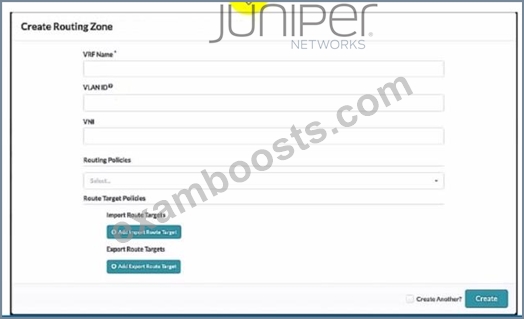
- A. VRF Name, VLAN ID. And VNI
- B. VRF Name, VLAN ID, VNI, Routing Policies
- C. VRF Name and Routing policies
- D. VRF Name only
Answer: A
Explanation:
To create a new routing zone, you must specify the VRF Name, VLAN ID, and VNI for the routing zone. These are the mandatory fields in the user interface shown in the exhibit. The VRF Name is the name of the L3 domain that isolates the IP traffic of the routing zone from other routing zones.
The VLAN ID is the identifier for the VLAN tagged Layer 3 links on external connections. The VNI is the VxLAN Network Identifier associated with the routing zone. The Routing Policies are optional fields that allow you to configure import and export route targets for the routing zone.
These are only applicable for EVPN routing zones, which use MP-EBGP as the overlay control protocol.
NEW QUESTION # 52
Which two statements ate correct about the information shown in the exhibit? (Choose two.)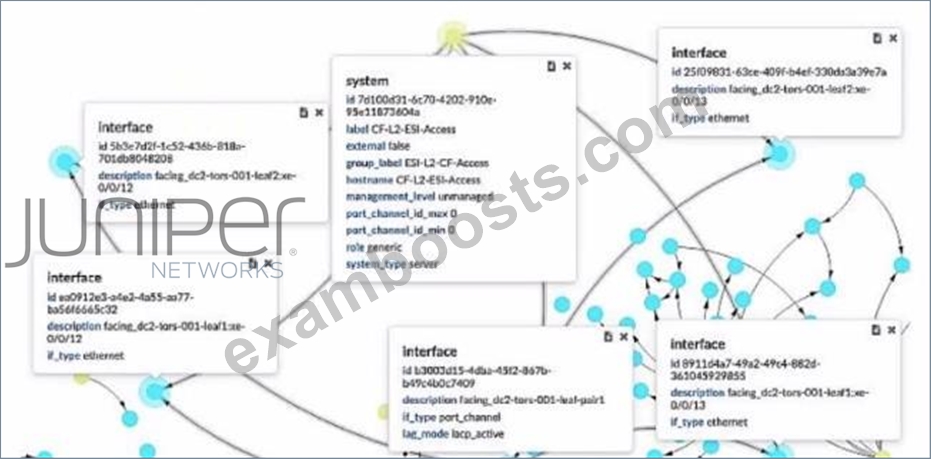
- A. The physical ports are not part of the LAG.
- B. The device shown is a generic system.
- C. The system is fully managed by Juniper Apstra.
- D. Four physical interfaces exist in a LAG facing the leaf pair.
Answer: B,D
Explanation:
A generic system is a device that is not managed by Juniper Apstra and does not have a specific role or type assigned to it. A generic system can be used to represent a server, a firewall, a load balancer, or any other device that is not part of the fabric. In the exhibit, the device shown is a generic system, as indicated by its role, system type, and management level. Therefore, the correct answer is B. The device shown is a generic system. A LAG is a link aggregation group that bundles multiple physical interfaces into a single logical interface. A LAG can provide increased bandwidth, redundancy, and load balancing for the network traffic. In the exhibit, the device shown has four physical interfaces that are part of a LAG, as indicated by their description and li_type. The LAG is facing the leaf pair, which are the two switches that connect to the device.
NEW QUESTION # 53
How does Apstra use Fabric Device Management to ensure consistency across the network?
- A. By enforcing uniform configurations on all network devices
- B. By assigning different agents to devices based on their location
- C. By randomly assigning system IDs to devices
- D. By adjusting the color-coding of cables in the data center
Answer: A
NEW QUESTION # 54
......
Get Instant Access REAL JN0-481 DUMP Pass Your Exam Easily: https://www.examboosts.com/Juniper/JN0-481-practice-exam-dumps.html
JN0-481 Free Exam Questions with Quality Guaranteed: https://drive.google.com/open?id=1Ya6NlDWSXI9HVbwpdCYUWT4rBcOzRNDM