

Salesforce-MuleSoft-Developer-I Self-Study Guide for Becoming an Salesforce Certified MuleSoft Developer I Expert
Salesforce-MuleSoft-Developer-I Study Guide Realistic Verified Salesforce-MuleSoft-Developer-I Dumps
Salesforce Salesforce-MuleSoft-Developer-I Exam Syllabus Topics:
| Topic | Details |
|---|---|
| Topic 1 |
|
| Topic 2 |
|
| Topic 3 |
|
| Topic 4 |
|
| Topic 5 |
|
| Topic 6 |
|
| Topic 7 |
|
| Topic 8 |
|
| Topic 9 |
|
| Topic 10 |
|
NEW QUESTION # 96
Refer to the exhibit.
What expression correctly specifies input parameters to pass the city and state values to the SQL query?
- A.

- B.

- C.

- D.

Answer: C
Explanation:
MuleSoft Documentation Reference : https://docs.mulesoft.com/db-connector/1.9/database-connector-select
NEW QUESTION # 97
Which of the below activity doesn't support parallel execution?
- A. Scatter-Gather Router
- B. Batch job
- C. First Successful Router
- D. Parallel For Each
Answer: D
Explanation:
The First Successful router iterates through a list of configured processing routes until one of the routes executes successfully. This is sequential execution. In all other options mentioned in the question ,we can achieve parallel execution.
NEW QUESTION # 98
Refer to the below exhibit.
A Mule application configures a property placeholder file named config.yaml to set some property placeholders for an HTTP connector.
What is the valid properties placeholder file to set these values?
- A. 1. http.host = localhost
2. http.port = 8081 - B. 1. {
2. http:
3. basePath: "api",
4. port: "8081", - C. 1. http:
2. basepath: "api"
3. host : "localhost"
4. port : "8081" - D. 1. http:
2. host = "localhost"
3. port = "8081"
Answer: C
Explanation:
5. host: " localhost"
Explanation:
Correct answer is as below as it follows the correct syntax.
http:
basepath: "api"
host : "localhost"
port : "8081"
Mule Doc Reference : https://docs.mulesoft.com/mule-runtime/4.3/mule-app-properties-to-configure
NEW QUESTION # 99
A Batch Job scope has five batch steps. An event processor throws an error in the second batch step because the input data is incomplete. What is the default behavior of the batch job after the error is thrown?
- A. All processing of the batch job stops.
- B. Event processing continues to the next batch step.
- C. Batch is retried
- D. Error is ignored
Answer: A
Explanation:
In case of an error , batch job completes in flight steps and stops further processing.
MuleSoft Doc Ref : Handling Errors During Batch Job | MuleSoft Documentation The default is all processing will stop but we can change it by Max Failed Record field.
General -> Max Failed Records: Mule has three options for handling a record-level error: Finish processing, Continue processing and Continue processing until the batch job accumulates a maximum number of failed records. This behavior can be controlled by Max Failed Records.
The default value is Zero which corresponds to Finish processing.
The value -1, corresponds to Continue processing.
The value +ve integer, corresponds to Continue processing until the batch job accumulates a maximum number of failed records
NEW QUESTION # 100
An HTTP Request operation sends an HTTP request with a non-empty JSON object payload to an external HTTP endpoint. The response from the external HTTP endpoint returns an XML body. The result is stored in a target named the Result.
What is the payload at the event processor after the HTTP Request?
- A. The original JSON request body
- B. null
- C. The XML response body
- D. A non-empty Java object
Answer: A
NEW QUESTION # 101
Where are values of query parameters stored in the Mule event by the HTTP Listener?
- A. Variables
- B. Payload
- C. Attributes
- D. Inbound Properties
Answer: C
Explanation:
Correct answer is Attributes.
Query parameters , URI parameters and headers are some of examples which are part of attributes.
Bottom of Form
Top of Form
NEW QUESTION # 102
A Mule project contains a MySQL Database dependency. The project is exported from Anypoint Studio so it can be deployed to CloudHub.
What export options create the smallest deployable archive that will successfully deploy to CloudHub?
What export option create their smallest deployable archive that will successfully deploy to CloudHub?
- A.

- B.

- C.

- D.

Answer: C
NEW QUESTION # 103
A Mule project contains a DataWeave module like WebStore.dwl that defines a function named loginUser. The module file is located in the project's src/main/resources/libs/etl folder.
What is correct DataWeave code to import all of the WebStore.dwl file's functions and then call the loginUser function for the login "[email protected]"?
- A. 1. 1. import libs.etl
2. 2. ---
3. 3. WebStore.loginUser("[email protected]") - B. 1. 1. import * from libs::etl::WebStore
2. 2. ---
3. 3. loginUser("[email protected]") - C. 1. 1. import * from libs::etl
2. 2. ---
3. 3. WebStore::loginUser("[email protected]") - D. 1. 1. import libs.etl.WebStore
2. 2. ---
3. 3. loginUser("[email protected]")
Answer: B
Explanation:
* To use custom modules, you need to import the module or functions you want to use by adding the import directive to the head of your DataWeave script, for example:
1) Does not identify any functions to import from the String module:
import dw::core::Strings
2) To identify a specific function to import from the String module:
import camelize, capitalize from dw::core::Strings
3) To import all functions from the String module:
import * from dw::core::Strings
The way you import a module impacts the way you need to call its functions from a DataWeave script. If the directive does not list specific functions to import or use * from to import all functions from a function module, you need to specify the module when you call the function from your script.
* In given scenario, it's mentioned to import all of the WebStore.dwl
So correct answer is:
NEW QUESTION # 104
What is output of Dataweave flatten function?
- A. Array
- B. Map
- C. LInkedHashMap
- D. Object
Answer: A
Explanation:
Correct answer is Array.
Flatten turns a set of subarrays (such as [ [1,2,3], [4,5,[6]], [], [null] ]) into a single, flattened array (such as [ 1, 2, 3, 4, 5, [6], null ]).
This example defines three arrays of numbers, creates another array containing those three arrays, and then uses the flatten function to convert the array of arrays into a single array with all values.
Source
%dw 2.0
output application/json
var array1 = [1,2,3]
var array2 = [4,5,6]
var array3 = [7,8,9]
var arrayOfArrays = [array1, array2, array3]
---
flatten(arrayOfArrays)
Output
[ 1,2,3,4,5,6,7,8,9 ]
NEW QUESTION # 105
Refer to the payload.

The Set payload transformer sets the payload to an object. The logger component's message attribute is configured with the string "Result #["INFO"++ payload]" What is the output of logger when this flow executes?
- A. Error : You evaluated inline expression # without ++
- B. Result INFOpayload
- C. Result INFO{"student":{"name":"Anay","age":6}}
- D. 1. 1. "You called the function '++' with these arguments:
2. 2. 1: String ("INFO")
3. 3: Object ({student: {name: "Anay" as String {class: "java.lang.String"},age: 6 as Numbe...)
Answer: D
Explanation:
Correct answer is as below as concatenation operation works only with string and not with the objects. In this case payload is object.
"You called the function '++' with these arguments:
1: String ("INFO")
2: Object ({student: {name: "Anay" as String {class: "java.lang.String"},age
NEW QUESTION # 106
Refer to the exhibits.
The Mule application does NOT define any global error handlers.
The Validation component in the private flow throws an error
What response message is returned to a web client request to the main flow's HTTP Listener?
- A. ''Child error"
- B. "Parent error"
- C. "Parent completed"
- D. "Validation Error"
Answer: D
NEW QUESTION # 107
Refer to the exhibits.


The Batch Job scope contains two Batch Step scopes with different accept expressions.
The input payload is passed to the Batch Job scope.
After the entire payload is processed by the Batch Job scope, what messages have been logged by the Logger components?
A)
B)

D)
- A. Option C
- B. Option D
- C. Option B
- D. Option A
Answer: A
NEW QUESTION # 108
How are multiple conditions used in a Choice router to route events?
- A. To route the same event to the matched route of EVERY true condition
- B. None of these
- C. To find the FIRST true condition, then route the same event to the matched route and ALL FOLLOWING routes
- D. To find the FIRST true condition, then distribute the event to the ONE matched route.
Answer: D
Explanation:
Choice router finds the FIRST true condition, then distribute the event to the ONE matched route.
MuleSoft Doc Ref : https://docs.mulesoft.com/mule-runtime/4.1/choice-router-concept The Choice router dynamically routes messages through a flow according to a set of DataWeave expressions that evaluate message content. Each expression is associated with a different routing option. The effect is to add conditional processing to a flow, similar to an if/then/else code block in most programming languages.
Only one of the routes in the Choice router executes, meaning that the first expression that evaluates to true triggers that route's execution and the others are not checked. If none of the expressions are true, then the default route executes.
NEW QUESTION # 109
Refer to the exhibits.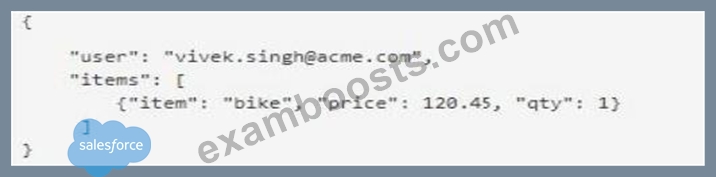


A Mule application is being developed to process web client POST requests with payloads containing order information including the user name and purchased items The Shipping connector returns a shipping address for the input payloads user name The Shipping connector's Shipping Address operation is configured with a target named shippingAddress.
The Set Payload transformer needs to set an item key equal to the items value from the original received payload and a shippinglnfo key equal to the the ShippingAddress operation's response What is a straightforward way to property configure the Set Payload transformer with the required data?
- A.

- B.

- C.

- D.

Answer: D
NEW QUESTION # 110
What is not the function of API Gateway ?
- A. Determine which traffic is authorized to pass through the API to backend services
- B. Logs all transactions , collecting and tracking analytics data
- C. Specify throttling , security and other policies
- D. Meter the traffic flowing through
Answer: C
Explanation:
Correct answer is Specify throttling , security and other policies
MuleSoft Doc Ref : https://docs.mulesoft.com/api-manager/2.x/api-gateway-capabilities-mule4 API Gateway is responsible for below functions.
1) Determine which traffic is authorized
2) Meter the traffic
3) Logs transaction
4) Apply throttling and other policies (Not specifying. These are specified in API Manager)
NEW QUESTION # 111
Refer to the exhibit. The Batch Job processes, filters and aggregates records, What is the expected output from the Logger component?

- A. [20, 40, 60]
- B. [20. 40] [60]
- C. [10. 20] [30, 40] [50, 60]
- D. [10. 20, 30. 40, 50, 60]
Answer: B
Explanation:
* Batch scope has filter criteria which says paylod mod 2 = 0 whch means only 2, 4 and 6 will be in batch scope.
* So payload for each of these will be incremented by 10.
* Aggregator has batch size defined as 2. So it will process in batch of two records.
* Hence option 3 is correct answer.
[20,40]
[60]
Behavior with aggregator configured with fixed size
In this scenario, the batch step sends the processed records to an aggregator, which starts processing the records and buffering them until the configured aggregator's size is reached. After that, the aggregator sends the aggregated records to the stepping queue.
The batch job builds record blocks of the configured block size and sends them to their corresponding batch step for processing. Each batch step receives one or more record blocks and starts processing them in parallel. After the batch step processes a record, the batch step sends the record to the aggregator for further processing. The aggregator continues processing records until the number of aggregated records reaches the configured aggregator's size.
https://docs.mulesoft.com/mule-runtime/4.3/batch-processing-concept
NEW QUESTION # 112
Refer to the exhibits.
The Mule application implements a REST API that accepts GET requests from web clients on the URLs: http://acme com/order/status and http:Vacme.com/customer/status.
What path value can be set in the HTTP GE~ event source to accept web client requests from both of these URLs?
- A. *[order,customer]/status
- B. */status
- C. *status
- D. ?[order,customer]/status
Answer: B
NEW QUESTION # 113
......
Valid Salesforce-MuleSoft-Developer-I Exam Dumps Ensure you a HIGH SCORE: https://www.examboosts.com/Salesforce/Salesforce-MuleSoft-Developer-I-practice-exam-dumps.html
Salesforce-MuleSoft-Developer-I Questions & Practice Test are Available On-Demand: https://drive.google.com/open?id=1AzOlj76sl8Tig_RrEqtbiwiLD1_VtgWi